
Digital marketing has become an important skill for students, fresh graduates, working professionals, entrepreneurs, and business owners. With businesses increasingly relying on search engines, social media, paid advertising, content, and online platforms to reach customers, learning digital marketing can open up several career and business opportunities.
However, choosing the right digital marketing course in Chandigarh can be challenging. Many institutes offer different course durations, modules, certifications, training methods, and career support options. The right choice should not be based only on course fees or the number of modules listed in a brochure.
A good digital marketing program should help you understand how different marketing channels work together and, more importantly, give you opportunities to apply what you learn through practical assignments and real-world projects.
Why Is Choosing the Right Digital Marketing Course Important?
Digital marketing is a broad field that includes search engine optimization, paid advertising, social media marketing, content, analytics, email marketing, lead generation, and several other areas.
Learning individual topics from disconnected sources can make it difficult to understand how these skills are used in an actual marketing campaign. A structured training program can provide a logical learning path, allowing you to build your knowledge step by step.
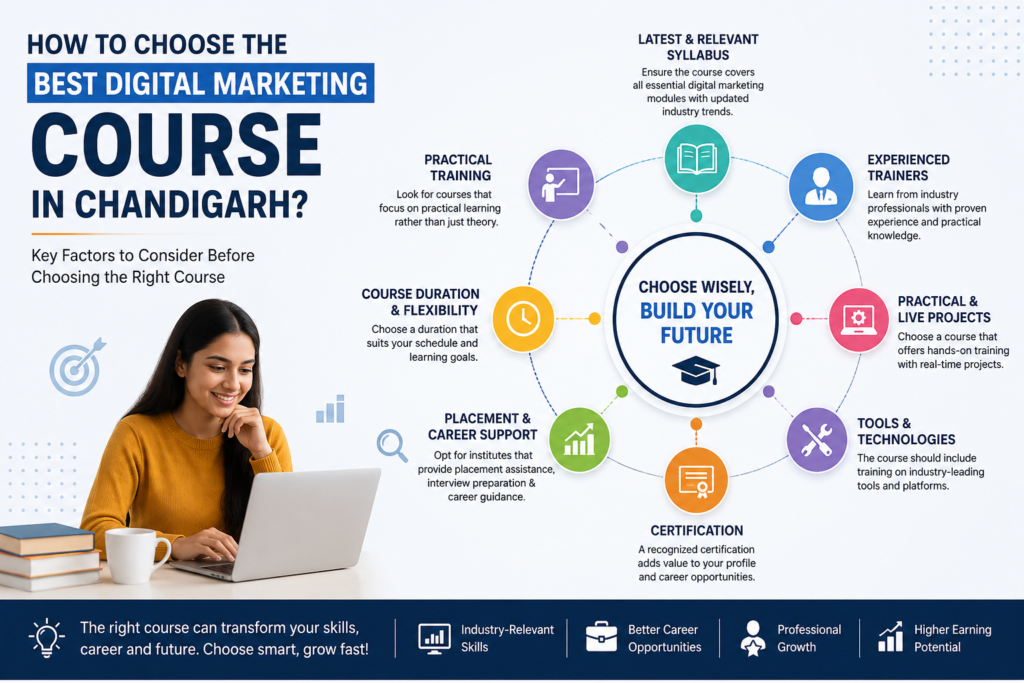
Before joining any digital marketing institute in Chandigarh, consider factors such as the curriculum, practical exposure, trainer experience, project work, tools covered, certification, and career support.
What Should You Look for in a Digital Marketing Course?
1. A Practical and Industry-Relevant Syllabus
The digital marketing industry keeps evolving, so the syllabus should cover current practices rather than focus only on basic concepts.
A comprehensive program may include areas such as:
- Search Engine Optimization (SEO)
- Google Ads and PPC advertising
- Social media marketing
- Meta advertising
- Content marketing
- Email marketing
- Web analytics
- Local SEO
- Lead generation
- Conversion optimization
- E-commerce marketing
- AI applications in digital marketing
The important point is not simply how many modules an institute lists. Look at whether the course explains how these skills are applied to actual marketing objectives.
2. Practical and Live Project Training
Digital marketing is a skill-based profession. Knowing definitions and theories is useful, but practical experience is what helps you understand how campaigns, websites, content, advertising platforms, and analytics work in real situations.
Look for practical digital marketing training that allows you to work on assignments, campaign examples, website optimization activities, keyword research, content planning, advertising exercises, analytics, or live projects.
Practical work can also help learners develop examples of their abilities that they can discuss during interviews or use when building a professional portfolio.
3. Trainers With Industry Experience
The person teaching a digital marketing course can significantly influence the quality of your learning experience.
Instead of looking only at academic qualifications, check whether the trainers have practical exposure to areas such as SEO, paid advertising, social media, analytics, content strategy, lead generation, or other digital marketing activities.
Industry experience can help trainers explain not only what a particular tool does, but also when and why marketers use it.
4. Coverage of SEO and Paid Advertising
SEO and paid advertising are two important components of modern digital marketing.
SEO helps businesses improve their organic visibility in search engines, while platforms such as Google Ads can help businesses reach users through paid campaigns.
A strong course should explain concepts such as keyword research, on-page optimization, technical SEO fundamentals, local SEO, campaign structure, audience targeting, ad creatives, conversion tracking, and performance analysis.
Understanding both organic and paid channels gives learners a broader view of how businesses acquire online traffic and leads.
5. Social Media and Content Marketing
Social media is more than simply publishing posts.
A useful training program should explain how businesses plan content, identify audiences, build engagement, create campaigns, measure performance, and use different platforms according to their marketing objectives.
Content marketing should also be covered because blogs, landing pages, social content, videos, emails, and other content formats often support SEO, lead generation, brand awareness, and customer acquisition.
6. Analytics and Performance Measurement
A marketer should know how to evaluate whether a campaign is actually working.
That’s why analytics should be an important part of any modern digital marketing training in Chandigarh.
Learners should understand basic performance indicators such as:
- Website traffic
- Leads
- Conversion rate
- Cost per lead
- Click-through rate
- Engagement
- Return on advertising spend
- User behaviour
The ability to interpret marketing data helps turn digital marketing from a collection of promotional activities into a measurable business function.
7. AI and Modern Digital Marketing Tools
Artificial intelligence is increasingly being used for research, content development, campaign analysis, automation, customer insights, and marketing workflows.
When comparing courses, check whether the training introduces practical applications of AI rather than simply mentioning “AI” as a module.
The goal should be to understand how AI can support a marketer’s work while maintaining human judgment, strategy, originality, and quality.
8. Certification and Portfolio Development
Certification can demonstrate that you completed a structured learning program, but it should not be the only reason for choosing a course.
Practical assignments and projects can be equally valuable because they give you something concrete to discuss with employers or clients.
Ideally, your learning journey should help you develop:
- Practical project experience
- Campaign understanding
- Marketing strategy skills
- Analytical thinking
- A professional portfolio
- Confidence with commonly used tools
How Important Is the Digital Marketing Course Syllabus?
The syllabus is one of the first things you should compare when evaluating different institutes.
However, don’t judge a syllabus simply by its length. A list containing dozens of topics does not necessarily mean that each topic will receive meaningful practical attention.
Instead, ask:
- Are the fundamentals explained properly?
- Does the course include practical assignments?
- Are current marketing tools covered?
- Is SEO taught beyond basic definitions?
- Does the program include paid advertising?
- Is analytics included?
- Are live projects part of the training?
- Does the syllabus include AI-powered marketing practices?
- Can the skills be applied to real business situations?
A well-structured curriculum should provide both conceptual understanding and practical application.
What About Digital Marketing Course Fees in Chandigarh?
Course fees can vary significantly between training providers. A lower fee does not automatically mean better value, and a higher fee does not guarantee better training.
When comparing digital marketing course fees, consider what is actually included in the program.
Look at factors such as:
- Course duration
- Number of training modules
- Practical sessions
- Live projects
- Trainer experience
- Tools and platforms covered
- Certification
- Portfolio development
- Career guidance
- Placement assistance, where applicable
Comparing the complete learning experience is more useful than comparing prices alone.
How Long Should a Digital Marketing Course Be?
There is no universal duration that makes one course better than another.
A beginner needs enough time to understand the fundamentals, practise different marketing channels, work on projects, and become comfortable with commonly used tools.
A very short program may provide an introduction, while a more comprehensive course can allow learners to explore multiple disciplines in greater depth.
Therefore, when comparing course duration, focus on what you will actually learn and practise during that period.
Who Can Join a Digital Marketing Course?
Digital marketing does not belong to one specific academic background. Depending on the program, it can be suitable for:
- College students
- Fresh graduates
- Working professionals
- Entrepreneurs
- Business owners
- Freelancers
- Sales and marketing professionals
- People looking to change careers
- Anyone interested in building digital marketing skills
The most important requirement is usually a willingness to learn, experiment, analyse results, and keep up with changes in digital platforms.
Why Practical Training Can Make a Difference
One of the biggest differences between simply studying digital marketing and learning it professionally is the opportunity to practise.
For example, reading about keyword research is different from actually researching keywords for a website. Understanding Google Ads terminology is different from planning a campaign structure. Learning about social media strategy is different from creating and evaluating a content plan.
This is why learners should look for a program that combines classroom or guided learning with practical digital marketing projects.
If you’re comparing training options, you can explore DIIM’s Digital Marketing Course in Chandigarh to review the curriculum, practical learning approach, and career-focused training structure.
A Simple Checklist Before Joining a Digital Marketing Institute
Before making your final decision, compare institutes using this checklist:
✓ Updated syllabus
Does the curriculum reflect current digital marketing practices?
✓ Practical training
Will you actually work on assignments and projects?
✓ Industry-experienced trainers
Can the trainers connect concepts with real marketing situations?
✓ SEO and paid advertising
Are both organic and paid acquisition channels covered?
✓ Social media and content
Will you learn how to create and evaluate marketing campaigns?
✓ Analytics
Will you learn how to measure campaign and website performance?
✓ AI tools and workflows
Does the course explain practical applications of AI in marketing?
✓ Portfolio or project work
Will you finish the course with practical work you can demonstrate?
✓ Career support
Does the institute provide guidance for interviews, portfolios, or job preparation?
✓ Learning environment
Does the training format suit your preferred way of learning?
Final Thoughts
Choosing the best digital marketing course in Chandigarh is ultimately about finding a program that matches your career goals, learning requirements, and preferred training style.
Instead of choosing an institute solely because of its fees, certificate, advertisements, or number of modules, evaluate the complete learning experience. Look for a relevant syllabus, practical training, experienced trainers, project exposure, analytics, AI applications, and career-oriented guidance.
If your goal is to build digital marketing skills that can be applied to real websites, campaigns, businesses, or professional projects, a practical and structured learning approach can provide a stronger foundation for your career.
Before enrolling, compare your options carefully, understand what the course actually includes, and choose a program that gives you opportunities to learn, practise, analyse, and improve.