
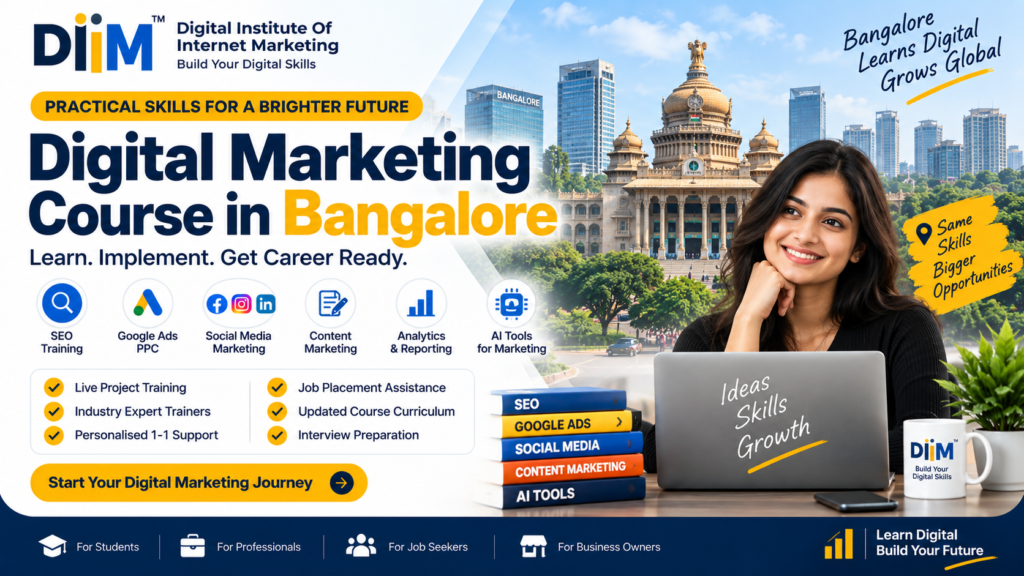
Digital marketing has become an important part of how businesses reach customers. Companies use search engines, social media, websites, email, paid advertising, and data to grow their online presence. This has also created new learning and career opportunities for people who want to build skills in online marketing.
A Digital Marketing Course in Bangalore can help learners understand how different digital channels work together. A good course should cover the basics first and then move into practical activities such as SEO research, campaign planning, content creation, social media work, analytics, and AI-assisted marketing.
Bangalore has a large mix of technology companies, startups, service businesses, e-commerce brands, professionals, and entrepreneurs. This makes digital skills useful for people with different career goals. Some may want to prepare for their first job, while others may want to improve their existing marketing skills, start freelancing, or promote a business.
This guide explains what you can learn through digital marketing training in Bangalore, what a course may include, how practical learning works, what skills matter, how to compare training programs, and what career options you can explore after learning digital marketing.
What Is Digital Marketing?
Digital marketing is the process of promoting a business, product, service, or brand through online channels. It includes both organic and paid methods used to attract people, generate interest, bring website visitors, and support sales or leads.
A digital marketing course for beginners usually starts with basic concepts before introducing individual marketing channels. Students can learn how search engines work, how websites attract visitors, how advertisements reach audiences, and how marketing results are measured.
Digital marketing can include:
- Search Engine Optimization (SEO)
- Google Ads and PPC
- Social media marketing
- Content marketing
- Email marketing
- Local SEO
- E-commerce marketing
- Lead generation
- Website marketing
- Analytics
- Conversion tracking
- AI-powered marketing
The purpose of learning digital marketing is not simply to learn different tools. It is also to understand the customer journey and how each marketing activity contributes to a business goal.
Why Are People Learning Digital Marketing in Bangalore?
Bangalore has a strong business and technology ecosystem, with companies operating across many industries. Digital marketing skills can therefore be useful in different types of businesses and roles.
People searching for digital marketing classes in Bangalore may have different reasons for joining a course. A student may want to understand the industry before starting a career, while a working professional may want to add marketing skills to an existing role.
Common reasons for learning digital marketing include:
- Preparing for an entry-level marketing role
- Developing practical marketing skills
- Learning SEO and website promotion
- Understanding paid advertising
- Managing social media
- Starting freelance services
- Promoting a business online
- Learning e-commerce marketing
- Building a marketing portfolio
- Understanding AI marketing tools
- Exploring a career change
The right course should match the learner’s actual goal rather than trying to teach every topic without enough practice.
What Does a Digital Marketing Course in Bangalore Teach?
A Digital Marketing Course in Bangalore can cover several areas of online marketing. The exact digital marketing course syllabus may differ between institutes, so it is important to check the complete curriculum before joining.
A structured course can introduce learners to SEO, paid advertising, social media, content, email, analytics, website marketing, and AI.
These modules should not be treated as completely separate subjects. For example, a business may use SEO to attract organic visitors, Google Ads to generate immediate traffic, social media to build awareness, and analytics to understand which channels are producing results.
Learning how these channels connect can help students understand digital marketing as a complete process.
What Are the Main Modules in Digital Marketing?
A complete digital marketing program should provide a balanced mix of search, advertising, content, social media, measurement, and technology. Each module develops a different skill that can later be used in practical projects.
1. Search Engine Optimization
SEO helps websites become more useful and visible for relevant search queries. Students learn how to research topics, understand search intent, optimize website pages, and monitor organic performance.
SEO training in Bangalore may cover:
- Keyword research
- Search intent
- On-page SEO
- Content optimization
- Technical SEO basics
- Internal linking
- Local SEO
- Competitor research
- Off-page SEO
- SEO performance analysis
For example, instead of simply placing a keyword repeatedly on a page, a learner can study what users actually want when they search for that term and then create useful content around that intent.
2. Google Ads and PPC Marketing
Google Ads allows businesses to advertise when people search for products, services, or information. PPC marketing requires more than creating an advertisement.
Google Ads training in Bangalore can introduce students to campaign planning, keyword selection, ad groups, bidding, budgets, landing pages, and conversion tracking.
A practical module may cover:
- Search campaigns
- Keyword research
- Match types
- Negative keywords
- Ad copy
- Campaign structure
- Audience targeting
- Conversion tracking
- Landing page basics
- Campaign reporting
Students can also learn how to read performance data and identify areas that need improvement.
3. Social Media Marketing
Social media marketing helps businesses communicate with their audience through platforms such as Facebook, Instagram, LinkedIn, and other relevant networks.
A social media marketing course in Bangalore can cover content planning, audience research, page management, creative ideas, engagement, and paid social campaigns.
Students may learn about:
- Social media strategy
- Content calendars
- Audience research
- Organic content
- Engagement
- Meta advertising
- Lead generation
- Creative testing
- Campaign reporting
The practical side of social media is important because marketers need to understand both content creation and performance.
4. Content Marketing
Content marketing uses useful information to attract and educate an audience. Content can appear on websites, blogs, social platforms, email campaigns, landing pages, and other digital channels.
Content marketing training can help students understand how to create content based on audience needs and search intent.
Important areas may include:
- Topic research
- Content planning
- Blog writing
- Copywriting
- Website content
- Landing page content
- Social media content
- Content optimization
- Calls to action
The aim should be to create content that helps the reader instead of writing only for search engines.
5. Email Marketing
Email marketing allows businesses to communicate with people who have already shown interest in their brand or services.
A basic email marketing module can explain how marketers create campaigns for different stages of the customer journey.
Students may learn:
- Email campaign planning
- Newsletter creation
- Audience segmentation
- Subject line writing
- Email automation concepts
- Customer communication
- Open and click measurement
- Conversion tracking
Email can be especially useful for businesses that want to maintain relationships with existing leads or customers.
6. Analytics and Conversion Tracking
Digital marketing becomes easier to improve when marketers understand their data.
Analytics can help answer questions such as where visitors came from, which pages they viewed, which campaigns generated leads, and where users stopped during a conversion journey.
Students may learn:
- Website traffic analysis
- Traffic sources
- User behaviour
- Campaign reporting
- Conversion tracking
- Lead measurement
- Performance comparison
- Basic marketing reports
For example, a website may receive many visitors but very few enquiries. Analytics can help a marketer investigate whether the problem is related to the landing page, offer, traffic source, or conversion process.
7. AI for Digital Marketing
AI tools are increasingly being used to support marketing work. They can help with research, brainstorming, content drafts, data organization, and repetitive tasks.
Modern AI tools for digital marketing can be used for:
- Content ideas
- Research assistance
- Keyword organization
- Ad copy drafts
- Content outlines
- Customer research
- Data summaries
- Workflow assistance
However, AI should support the marketer rather than replace marketing thinking. Information still needs to be checked, and the final content should match the audience, brand, and business objective.
Why Is Practical Training Important?
Digital marketing is a skill-based field. Reading about SEO, Google Ads, or social media is different from actually performing a marketing task.
Practical digital marketing training gives students opportunities to apply what they learn. This may include assignments, website exercises, SEO audits, campaign planning, content tasks, analytics exercises, and project work.
Practical learning can help students develop:
- Hands-on experience
- Marketing problem-solving
- Tool familiarity
- Analytical thinking
- Campaign understanding
- Portfolio projects
- Confidence with marketing tasks
Students comparing digital marketing coaching in Bangalore should therefore ask how much practical work is included rather than looking only at the number of modules.
How Should You Choose a Digital Marketing Institute in Bangalore?
Choosing a training institute requires more than comparing advertisements. Students should look at what they will actually learn and practise during the course.
When comparing a digital marketing institute in Bangalore, consider the syllabus, trainer experience, practical sessions, projects, support, and career assistance.
Check the Course Syllabus
Start with the complete curriculum. Make sure the course covers the areas that match your career goal.
A broad program may include:
- SEO
- Google Ads
- Meta Ads
- Social media marketing
- Content marketing
- Email marketing
- Analytics
- Local SEO
- E-commerce marketing
- Lead generation
- AI tools
The syllabus should also explain whether students will practise these topics.
Check Practical Training
A syllabus can contain many topics without providing enough hands-on work.
Ask whether students get practical assignments, campaign exercises, website tasks, SEO projects, content work, analytics practice, or other project-based activities.
Check Trainer Experience
Trainer experience can influence how practical the lessons are. Ask about the trainer’s background and whether examples are based on real marketing situations.
A trainer who can explain why a marketing decision is made can help learners understand the thinking behind the process.
Check Learning Support
Digital marketing involves several tools and concepts. Beginners may need help while working on assignments.
Before joining, check whether the institute provides doubt support, feedback, practice guidance, or additional learning material.
Ask About Projects
Projects help learners combine different skills.
For example, a project might involve keyword research, website optimization, content planning, social media strategy, advertising structure, and performance reporting.
Understand Career Support
If your goal is a job, ask what career support is actually provided.
This may include:
- Resume guidance
- Interview preparation
- Portfolio development
- Communication practice
- Job-readiness sessions
- Career guidance
- Placement assistance
Always understand the exact terms and conditions of any placement-related claim before enrolling.
Who Can Join a Digital Marketing Course?
Digital marketing can be learned by people from different educational and professional backgrounds. You do not necessarily need a marketing degree to begin learning the fundamentals.
A digital marketing course for beginners can be suitable for:
- College students
- Graduates
- Freshers
- Job seekers
- Working professionals
- Entrepreneurs
- Business owners
- Freelancers
- Sales professionals
- Career switchers
Basic computer knowledge and a willingness to practise can provide a useful starting point.
Can Freshers Start a Digital Marketing Career?
Freshers can learn digital marketing and apply for suitable entry-level roles. However, completing a course by itself does not guarantee employment.
Employers may consider practical knowledge, communication, analytical thinking, portfolio work, and familiarity with relevant tools.
Possible entry-level roles include:
- Digital Marketing Executive
- SEO Executive
- PPC Executive
- Social Media Executive
- Content Marketing Executive
- Marketing Assistant
- E-commerce Marketing Executive
A fresher can use practical projects to show what they can actually do rather than relying only on a certificate.
Which Digital Marketing Skills Should You Learn?
Digital marketing combines technical, creative, and analytical work. Building a balanced skill set can help learners understand more than one part of the marketing process.
SEO Skills
SEO skills help marketers understand search queries, keywords, content, website structure, and organic visibility.
Paid Advertising Skills
Paid advertising requires knowledge of targeting, campaign structure, budgets, ad messages, landing pages, and performance measurement.
Social Media Skills
Social media marketers need to understand audience behaviour, content formats, engagement, creative planning, and campaign objectives.
Content Skills
Writing and communication skills are useful for blogs, website pages, advertisements, emails, social posts, and landing pages.
Analytics Skills
Analytics helps marketers understand campaign results and make decisions using data.
Communication Skills
Marketers often work with business owners, clients, designers, developers, sales teams, and other departments. Clear communication is therefore an important professional skill.
Problem-Solving Skills
Marketing campaigns can produce unexpected results. A marketer needs to identify possible problems, study the data, and test improvements.
AI Skills
AI tools can improve productivity, but marketers still need to review outputs, check facts, and make strategic decisions.
What Career Opportunities Are Available After Digital Marketing Training?
Digital marketing skills can lead to different roles depending on a person’s interests and strengths.
Someone who enjoys search may focus on SEO. A person interested in advertising may explore PPC or performance marketing. Others may prefer content, social media, analytics, or e-commerce.
Possible digital marketing career options include:
- Digital Marketing Executive
- SEO Executive or Specialist
- PPC Executive
- Performance Marketing Executive
- Social Media Executive
- Content Marketing Executive
- Email Marketing Executive
- E-commerce Marketing Executive
- Digital Marketing Analyst
- Marketing Coordinator
Career opportunities and compensation can vary based on skills, experience, company, industry, role, and responsibilities.
Can Digital Marketing Skills Be Used for Freelancing?
Yes. Digital marketing skills can also be offered as freelance services.
A freelancer may choose one specialization or combine several related services.
Common freelance services include:
- SEO
- Local SEO
- Social media management
- Google Ads
- Meta Ads
- Content writing
- Website optimization
- Lead generation
- Email marketing
Starting with a focused service can make it easier to build experience and create a portfolio.
Freelancers also need skills beyond marketing. Client communication, project management, pricing, reporting, deadlines, and relationship management are important parts of freelance work.
Can Business Owners Learn Digital Marketing?
Business owners can learn digital marketing to better understand how their online marketing activities work.
They do not necessarily need to become full-time marketers. Even basic knowledge can help them understand website traffic, search visibility, advertising, social media, leads, and conversions.
A business owner can learn how:
- Customers discover businesses online
- SEO supports search visibility
- Paid advertising generates traffic
- Social media supports customer communication
- Website pages influence enquiries
- Analytics helps measure performance
This knowledge can also make it easier to communicate with an agency or internal marketing team.
Online vs Classroom Digital Marketing Learning
Both online and classroom learning can be useful. The right choice depends on the learner’s schedule, learning style, and need for direct interaction.
Online Learning
Online learning provides flexibility and can be useful for people who have work, college, or other responsibilities.
It may suit learners who:
- Prefer flexible schedules
- Want to study from home
- Have limited travel time
- Prefer self-paced learning
Classroom Learning
Classroom-based digital marketing classes in Bangalore provide direct interaction with trainers and other students.
This can be useful for learners who prefer:
- Face-to-face teaching
- Direct doubt solving
- A fixed learning routine
- Classroom activities
- Group discussions
- Practical sessions
The delivery format is only one factor. The actual syllabus, trainer support, projects, and practical work should also be compared.
How Much Do Digital Marketing Course Fees in Bangalore Cost?
Digital marketing course fees in Bangalore can vary between institutes and programs. There is no single fee that applies to every course.
The total cost may depend on:
- Course duration
- Number of modules
- Practical training
- Trainer experience
- Live or simulated projects
- Tools included
- Certification
- Career support
- Classroom or online format
- Advanced specializations
Instead of comparing price alone, compare what you receive for that fee.
Check the complete curriculum, number of practical sessions, project work, support, certification, and career services before deciding which program fits your requirements.
How Long Does It Take to Learn Digital Marketing?
The time required depends on the learner’s starting level, course structure, and practice routine.
A beginner can start with digital marketing fundamentals and then learn individual channels one by one. Regular practice can help turn theoretical knowledge into usable skills.
A simple learning path can be:
Learn the Basics → Practise Each Skill → Complete Projects → Analyse Results → Improve → Build a Portfolio
Digital marketing is also an ongoing learning field. Search algorithms, advertising platforms, social networks, analytics systems, and AI tools can change over time.
Can Digital Marketing Help With a Career Change?
Digital marketing can be an option for professionals who want to move toward marketing-related work.
For career switchers, practical projects can be especially useful because they show how newly learned skills can be applied.
A career-change learner can focus on:
- Understanding digital marketing fundamentals.
- Selecting relevant specializations.
- Practising through assignments.
- Completing practical projects.
- Building a portfolio.
- Improving communication skills.
- Preparing for suitable job roles.
- Continuing to learn after entering the field.
Previous professional experience may also be useful. For example, someone from sales may already understand customer communication, while a designer may have useful creative skills.
How Is AI Changing Digital Marketing Work?
AI is changing how marketers handle research, content, analysis, and repetitive tasks.
Marketers can use AI to support:
- Content research
- Idea generation
- First drafts
- Data organization
- Customer research
- Marketing outlines
- Reporting assistance
- Repetitive workflows
But AI-generated output should not be accepted without review. Marketers still need to check accuracy, understand the audience, maintain brand quality, and make strategic decisions.
This is why modern digital marketing training in Bangalore can combine core marketing skills with practical AI usage.
What Should You Check Before Joining a Digital Marketing Course?
Before enrolling, create a simple checklist. It can help you compare different training programs without focusing only on promotional claims.
Check:
- Complete course syllabus
- Practical assignments
- Live project experience
- Trainer background
- Learning format
- Doubt support
- Learning resources
- Certification
- Portfolio development
- Career assistance
- Course duration
- Total fees
- Batch size
- Demo class
A course should be judged by what it actually provides. Words such as “best,” “advanced,” or “professional” do not explain the quality of the learning experience by themselves.
How Can You Start Learning Digital Marketing?
Starting with a structured plan can make the learning process easier. Beginners do not need to master every channel immediately.
Start with the fundamentals and then build practical skills step by step.
A useful learning path is:
Step 1: Understand digital marketing basics
Step 2: Learn SEO and search intent
Step 3: Study Google Ads and PPC
Step 4: Learn social media marketing
Step 5: Understand content marketing
Step 6: Learn analytics and conversion tracking
Step 7: Explore email and e-commerce marketing
Step 8: Practise through projects
Step 9: Create a portfolio
Step 10: Prepare for jobs, freelancing, or business marketing
The most important part is to practise while learning.
Final Thoughts
A Digital Marketing Course in Bangalore can provide a structured path for people who want to develop online marketing skills. A useful program should combine concepts with practical activities so learners can understand how different digital channels work in real marketing situations.
Before selecting a digital marketing institute in Bangalore, compare the syllabus, practical training, trainer experience, project work, learning support, fees, certification, and career assistance.
Digital marketing also provides multiple areas to explore. You can focus on SEO, Google Ads, social media, content, analytics, e-commerce, performance marketing, freelancing, or broader digital marketing roles.
The best way to begin is to identify your goal, learn the relevant skills, practise regularly, and build evidence of your work through projects and a portfolio.
Explore Related Digital Marketing Courses
If you want to explore specific digital marketing skills along with your main training, these related DIIM courses can be useful:
| Course / Topic | Explore Course |
|---|---|
| Digital Marketing | Digital Marketing Course |
| Google Ads & PPC | Google Ads Course Chandigarh |
| Facebook & Meta Advertising | Facebook & Meta Ads Course |
| Affiliate Marketing | Affiliate Marketing Course |
| Dropshipping & E-Commerce | Dropshipping Course Chandigarh |
| Blogging & Online Income | Make Money Online Course |
Frequently Asked Questions
1. What is a Digital Marketing Course in Bangalore?
A Digital Marketing Course in Bangalore teaches important online marketing methods such as SEO, Google Ads, social media marketing, content marketing, email marketing, analytics, and AI tools. Practical assignments can help learners apply these concepts.
2. Is digital marketing suitable for beginners?
Yes. Beginners can start with basic concepts and gradually learn SEO, paid advertising, social media, content, analytics, and other digital marketing skills.
3. What does a digital marketing course syllabus include?
A digital marketing course syllabus may include SEO, Google Ads, Meta Ads, social media marketing, content marketing, email marketing, analytics, local SEO, e-commerce marketing, lead generation, and AI tools.
4. What are digital marketing course fees in Bangalore?
Digital marketing course fees in Bangalore vary depending on the institute, course duration, syllabus, practical training, projects, certification, and career support.
5. Can freshers get digital marketing jobs?
Freshers can apply for entry-level marketing roles after developing relevant skills. Practical projects, communication ability, and knowledge of marketing tools can help demonstrate their capabilities.
6. Is practical training important in digital marketing?
Yes. Practical training allows learners to apply concepts through assignments, projects, campaign exercises, SEO work, content tasks, and analytics activities.
7. Can I learn SEO through digital marketing training in Bangalore?
Yes. SEO is commonly included in digital marketing programs and may cover keyword research, search intent, on-page SEO, technical basics, content optimization, local SEO, and performance analysis.
8. Can I learn Google Ads through a digital marketing course?
Yes. Google Ads training can cover campaign structure, keyword targeting, ad creation, bidding, budgets, landing pages, and conversion tracking.
9. Can digital marketing skills help with freelancing?
Yes. Freelancers can offer services such as SEO, social media management, Google Ads, Meta Ads, content writing, lead generation, and website optimization.
10. Can business owners learn digital marketing?
Yes. Business owners can learn digital marketing to better understand SEO, advertising, social media, website traffic, lead generation, and online customer acquisition.
11. Does digital marketing training include AI tools?
Many modern programs include AI tools for digital marketing for research, content assistance, data organization, idea generation, and workflow support.
12. How should I choose a digital marketing institute in Bangalore?
Compare the syllabus, practical sessions, trainers, projects, learning support, fees, certification, and career assistance. A demo class can also help you understand the teaching style before enrolling.