
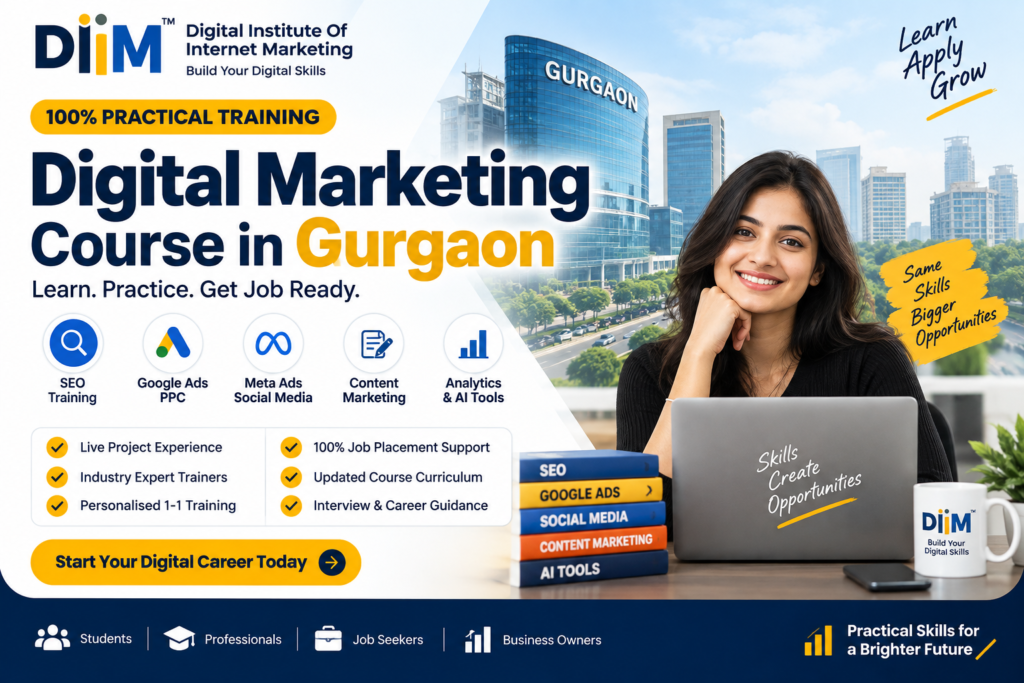
Gurgaon, officially known as Gurugram, has become an important business and technology centre in the National Capital Region. Many companies, startups, agencies, e-commerce brands, and service businesses depend on online channels to attract customers. This has increased the need for people who understand how digital marketing works.
A Digital Marketing Course in Gurgaon can help learners understand the complete online marketing process, from finding the right audience to generating traffic, leads, and sales. The learning journey can include SEO, paid advertising, social media, content, analytics, email marketing, and AI-powered tools.
For a student or professional, choosing the right course is not only about finding a digital marketing institute in Gurgaon. It is also important to understand what you will learn, how much practical work is included, who will train you, and how the skills can be used after the course.
This guide explains the important areas to consider before joining digital marketing training in Gurgaon, including the syllabus, practical learning, career paths, freelancing, and important skills.
What Is Digital Marketing?
Digital marketing is the process of promoting products, services, brands, or businesses through digital channels. These channels can include Google search, websites, social media platforms, email, online advertisements, and other internet-based platforms.
Think of a local business that wants more customers. It can create a website, optimize it for search engines, run Google Ads, publish useful content, and use social media to stay connected with its audience. Each activity has a different purpose, but they can work together as one marketing system.
A digital marketing course for beginners should therefore teach more than individual tools. It should explain why a business uses each channel, what type of customer it can reach, and how performance can be measured.
Why Is Digital Marketing Becoming an Important Skill in Gurgaon?
Gurgaon’s business environment includes technology firms, startups, corporate offices, agencies, retailers, online businesses, and professional service providers. Their marketing needs can differ, but many of them use digital platforms to communicate with potential customers.
This makes digital marketing training in Gurgaon relevant for people who want to build skills connected with modern business communication and customer acquisition.
Different learners may have different reasons for studying the field:
- A student may want to understand the digital industry before entering the job market.
- A fresher may want practical skills for an entry-level role.
- A working professional may want to add digital skills to an existing career.
- A business owner may want to understand online customer acquisition.
- A freelancer may want to offer marketing services to clients.
- A career changer may want to explore a new professional field.
The important part is to choose a learning path that matches your actual goal.
What Can You Learn in a Digital Marketing Course in Gurgaon?
A complete Digital Marketing Course in Gurgaon can cover several areas of online marketing. Instead of treating every channel as a separate subject, learners should understand how these activities connect.
For example, SEO can bring visitors from organic search. Paid advertising can reach people through targeted campaigns. Social media can build awareness and engagement, while content can answer questions and educate potential customers.
A course may include:
- Search Engine Optimization
- Google Ads and PPC
- Social Media Marketing
- Content Marketing
- Email Marketing
- Web Analytics
- Conversion Tracking
- Local SEO
- E-commerce Marketing
- Lead Generation
- AI for Digital Marketing
- Website and WordPress Marketing
The exact modules and depth can vary between training providers, so checking the complete digital marketing course syllabus before admission is important.
What Are the Main Modules of Digital Marketing?
Digital marketing has several branches, and each one requires a different approach. A good learning program introduces these areas step by step so that students can understand both the individual skills and their relationship with business goals.
Search Engine Optimization
SEO helps websites improve their visibility in unpaid search results. It involves understanding what people search for and making website pages more useful and accessible to both users and search engines.
SEO training in Gurgaon can cover keyword research, search intent, on-page optimization, technical SEO, content optimization, internal linking, local SEO, and performance monitoring.
Students can practise tasks such as:
- Finding relevant search terms
- Understanding search intent
- Optimizing page titles and headings
- Improving website content
- Checking basic technical issues
- Planning internal links
- Studying organic performance
SEO is generally a long-term activity, so learners should understand that useful content and sound website optimization are more important than simply inserting keywords.
Google Ads and PPC Marketing
Google Ads allows businesses to advertise to people through paid placements across Google’s advertising network. Search campaigns are particularly useful when a business wants to reach people who are already searching for specific products or services.
Google Ads training can introduce learners to campaign structures, keyword selection, ad copy, bidding, budgets, landing pages, and conversion tracking.
Important PPC advertising concepts include:
- Search campaigns
- Keyword targeting
- Match types
- Negative keywords
- Ad groups
- Bidding
- Budget control
- Landing page relevance
- Conversion measurement
Practical campaign exercises can make these concepts easier to understand.
Social Media Marketing
Social media gives businesses a way to communicate with their audience through content, community interaction, and paid campaigns.
A social media marketing course in Gurgaon may teach content planning, audience research, platform selection, creative formats, engagement, paid promotion, and performance analysis.
A strong social strategy starts with the audience. A business should know what it wants to communicate and what action it wants users to take.
Content Marketing
Content marketing focuses on creating information that is useful to a specific audience. This can include blogs, guides, videos, social media posts, newsletters, case studies, and other formats.
Content marketing can support several parts of a digital strategy. Useful articles can answer search queries, educational posts can build awareness, and product-focused content can help potential customers understand an offering.
Learners can develop skills in:
- Topic research
- Content planning
- Blog writing
- Search intent analysis
- Content calendars
- Basic SEO writing
- Editing
- Content distribution
Email Marketing
Email remains useful for businesses that want to communicate directly with subscribers and existing customers.
A course may cover email list management, segmentation, campaign planning, copywriting, basic automation, and performance tracking.
For example, an online store can use email to introduce new products, while an educational business can use it to share useful learning material with subscribers.
Analytics and Conversion Tracking
Marketing activity needs measurement. Analytics helps marketers understand where users are coming from and what they do after reaching a website.
Learners can study metrics related to:
- Website traffic
- User engagement
- Leads
- Purchases
- Conversion rates
- Campaign performance
- Traffic sources
Conversion tracking is especially important because it connects marketing activity with business actions such as purchases, enquiries, registrations, calls, or form submissions.
AI for Digital Marketing
AI tools are increasingly being used in marketing workflows. They can help marketers brainstorm ideas, organize research, analyse information, create content outlines, and improve productivity.
A modern course can introduce AI tools for digital marketing while also teaching students how to check AI-generated information and maintain quality.
The useful skill is not simply knowing how to use an AI tool. It is knowing when to use it, what to ask, how to verify the output, and how to apply the result to a marketing objective.
Why Should a Digital Marketing Course Include Practical Training?
Reading about SEO, advertising, or analytics gives you knowledge, but applying that knowledge creates practical understanding.
For example, someone may know what keyword research means but still struggle to create a useful keyword list for an actual website. Similarly, knowing the definition of PPC does not mean a person knows how to structure a campaign.
This is why practical digital marketing training should include activities where learners actually perform marketing tasks.
Practical work can involve:
- Website SEO exercises
- Keyword research
- Content planning
- Campaign structure exercises
- Social media calendars
- Analytics analysis
- Conversion tracking
- Landing page reviews
- Local SEO tasks
- AI-assisted marketing workflows
Projects can also help learners create work samples that demonstrate their skills.
How Can You Choose the Right Digital Marketing Institute in Gurgaon?
There are many ways to compare training providers. Looking only at advertisements or fees can leave out important details about the actual learning experience.
When comparing a digital marketing institute in Gurgaon, look at the course structure, trainer background, practical work, projects, support, and career preparation.
Review the Course Syllabus
Start by asking for the complete syllabus. A broad program should cover the core areas of digital marketing rather than focusing entirely on one platform.
Check whether it includes:
- SEO
- Google Ads
- Social media
- Content marketing
- Email marketing
- Analytics
- Conversion tracking
- Local SEO
- E-commerce marketing
- AI tools
Look at the Practical Work
Ask what students actually do during the course.
A useful program should give learners opportunities to work on assignments, websites, campaigns, reports, or projects rather than only watching demonstrations.
Understand the Trainer’s Experience
Ask about the trainer’s practical industry experience. Someone who has worked on different marketing situations may be able to explain concepts using real examples.
The ability to explain difficult topics in simple language is also important for beginners.
Check Learning and Doubt Support
Digital marketing includes many platforms and technical terms. Learners may need help while completing assignments.
Check whether the program provides doubt sessions, mentor support, practice assistance, or feedback on project work.
Ask About Projects
Projects can help learners move from theory to application.
Before joining, ask:
- What type of projects will students complete?
- Are projects based on websites or campaigns?
- Will students analyse actual data?
- Can project work be used in a portfolio?
- Will trainers review the work?
Understand Career Support
If your goal is employment, check the exact career services provided by the institute.
These may include resume development, interview preparation, communication training, portfolio guidance, job referrals, or placement assistance.
Understand the actual service instead of assuming that every course’s “placement” wording means the same thing.
Who Can Join a Digital Marketing Course?
Digital marketing can be learned by people from different academic backgrounds. A specific degree is not necessarily required to begin learning the fundamentals.
A structured digital marketing course for beginners can help someone starting from zero, while professionals can focus on areas that complement their existing experience.
The field can be explored by:
- College students
- Graduates
- Freshers
- Job seekers
- Working professionals
- Business owners
- Entrepreneurs
- Freelancers
- Website owners
- Career changers
Your previous experience can also influence which specialization you choose later.
Can Freshers Build a Career in Digital Marketing?
Freshers can prepare for entry-level digital marketing roles by developing practical knowledge and creating examples of their work.
Employers can look at different factors, including technical understanding, communication, analytical ability, creativity, and practical exposure. Requirements differ between organizations and roles.
Some entry-level positions include:
- Digital Marketing Executive
- SEO Executive
- PPC Executive
- Social Media Executive
- Content Marketing Executive
- Email Marketing Executive
- Digital Marketing Intern
A beginner can create a simple portfolio with work such as an SEO audit, keyword research document, content calendar, sample campaign structure, or website analysis.
Which Digital Marketing Skills Should You Learn?
Digital marketing combines several types of skills. Technical knowledge helps with tools, while communication and analytical thinking help marketers understand problems and explain solutions.
Important digital marketing skills include:
SEO and Search Skills
Learn how search engines work, how people search for information, and how website pages can be optimized.
Paid Advertising Skills
Understand campaign structures, targeting, keywords, bidding, budgets, advertisements, landing pages, and conversion measurement.
Social Media Skills
Learn how to plan content, understand audiences, select suitable platforms, measure engagement, and work with paid social campaigns.
Content Skills
Learn research, writing, editing, topic selection, content planning, and basic search optimization.
Analytics Skills
Understand marketing data and use reports to identify traffic patterns, user actions, and conversion performance.
Communication Skills
Marketers often explain strategies and results to clients or other teams. Clear communication can therefore be useful in both agency and in-house roles.
Problem-Solving Skills
Campaigns can produce unexpected results. Marketers need to investigate the available information and identify possible areas for improvement.
AI Skills
Learn how to use AI responsibly for research, ideation, content workflows, analysis, and productivity while maintaining human review.
What Career Paths Can Digital Marketing Skills Open?
Digital marketing is a broad field, so learners can move toward different specializations as they gain experience.
Possible digital marketing career options include:
- Digital Marketing Executive
- SEO Executive or Specialist
- PPC Specialist
- Performance Marketing Specialist
- Social Media Marketer
- Content Marketer
- Email Marketing Specialist
- Digital Marketing Analyst
- E-commerce Marketing Specialist
- SEO Content Strategist
- Digital Marketing Consultant
The actual requirements for each position depend on the employer and level of the role. Specialization can become easier after gaining practical experience across the basic channels.
Can Digital Marketing Skills Be Used for Freelancing?
Yes. Freelancers can provide digital marketing services to businesses, agencies, creators, and other clients.
Common freelance services include SEO, content writing, social media management, Google Ads management, website optimization, local SEO, and analytics support.
But freelancing also involves client communication and business management. You need to understand requirements, agree on project scope, manage deadlines, prepare reports, and communicate progress.
A beginner can start by building expertise in a focused service rather than offering every digital marketing service immediately.
For example, someone interested in SEO could first offer keyword research and on-page optimization before expanding into technical audits and larger SEO projects.
Can Business Owners Learn Digital Marketing?
Business owners can learn digital marketing to better understand how online marketing activities support their business.
They may not need to become specialists in every channel. Instead, they can learn enough to understand marketing plans, review reports, communicate with agencies, and identify areas that need attention.
Useful areas include:
- Customer research
- Local SEO
- Website optimization
- Lead generation
- Google Ads
- Social media
- Content marketing
- Analytics
- Conversion tracking
This knowledge can also help business owners make clearer decisions when allocating marketing budgets.
Online vs Classroom Digital Marketing Learning
The choice between online and classroom learning depends on personal preferences, schedule, location, and the amount of interaction a learner wants.
The delivery method is only one factor. Course quality, practical work, trainer support, and project experience should also be considered.
Online Digital Marketing Learning
An online digital marketing course can be useful for people who want flexible learning. Students can often study from home and manage lessons around college, work, or other responsibilities.
This format may suit learners who prefer:
- Flexible schedules
- Remote learning
- Recorded lessons
- Self-paced revision
- Learning from home
Classroom Digital Marketing Learning
Classroom learning allows students to interact directly with trainers and classmates.
It may be useful for learners who prefer:
- Fixed class schedules
- Face-to-face discussions
- Immediate questions and answers
- Group activities
- Direct practical guidance
The important question is whether the chosen format provides enough opportunities to practise.
How Long Does It Take to Learn Digital Marketing?
There is no single learning period that works for everyone. The time depends on the course depth, study schedule, previous experience, and amount of practice.
Understanding basic concepts may take less time than becoming comfortable with multiple platforms and completing independent projects.
A practical learning journey can be divided into stages:
Learn the concept → Practise the skill → Complete a project → Analyse the result → Improve the work
Continuous practice is particularly important because digital platforms, tools, and marketing practices continue to change.
What Should You Check Before Paying for a Course?
Before enrolling, compare the complete course rather than looking only at the advertised price.
If you are researching digital marketing course fees in Gurgaon, also check what those fees include.
Consider the following:
- Complete syllabus
- Course duration
- Practical assignments
- Live project opportunities
- Trainer experience
- Tools covered
- Doubt support
- Portfolio development
- Analytics training
- AI training
- Certification details
- Career support
- Placement assistance
- Additional charges, if any
A lower course fee does not necessarily mean the program covers the same material as a higher-priced course, so compare the actual learning value and inclusions.
Can Digital Marketing Be Useful for a Career Change?
Digital marketing can be explored by professionals who want to move into a different field. Existing experience can sometimes provide a useful foundation.
For example, sales professionals may already understand customer communication and lead generation. Someone from writing or media may have transferable content skills. A business professional may already understand customer needs and commercial objectives.
Adding digital marketing skills to those existing strengths can create a different professional profile.
A career transition still requires learning, practice, portfolio building, and preparation for the requirements of the target role.
How Is AI Changing Digital Marketing Work?
AI is influencing many parts of digital marketing. Marketers can use AI tools to speed up research, generate ideas, organize information, create initial drafts, and support data analysis.
But marketing decisions still require context. AI-generated material needs human checking for accuracy, originality, brand suitability, and usefulness.
Learners should therefore develop two skills together:
Marketing knowledge + responsible AI usage
This approach can help marketers use technology without losing the strategic and creative parts of their work.
How Can You Start Learning Digital Marketing?
If you are completely new to the field, starting with every tool at once can become confusing. A step-by-step approach is easier to manage.
A practical learning sequence can be:
- Understand digital marketing fundamentals.
- Learn how search engines and SEO work.
- Study Google Ads and PPC.
- Explore social media marketing.
- Learn content marketing.
- Understand analytics and conversion tracking.
- Explore email and e-commerce marketing.
- Learn useful AI marketing tools.
- Practise each major skill.
- Complete marketing projects.
- Build a practical portfolio.
- Prepare for jobs, internships, or freelance work.
If you are planning to join digital marketing coaching in Gurgaon, use this sequence as a checklist when comparing the course syllabus.
Final Thoughts
Learning digital marketing is not simply about collecting certificates or learning a long list of tools. The more useful goal is to understand how different marketing activities solve real business problems.
A Digital Marketing Course in Gurgaon can introduce learners to SEO, Google Ads, social media, content marketing, analytics, email marketing, e-commerce, and AI. Practical projects can then help turn those concepts into usable skills.
Before selecting a digital marketing institute in Gurgaon, compare the syllabus, trainer experience, practical assignments, projects, learning support, certification, and career assistance.
If your goal is employment, focus on job-ready skills and portfolio work. If you want freelancing, develop a clear service and learn client management. If you own a business, focus on the channels that can support your customer acquisition goals.
The learning path can be different for every person, but consistent practice and a strong understanding of digital marketing fundamentals can provide a useful foundation for continued growth.
Frequently Asked Questions
1. What is a Digital Marketing Course in Gurgaon?
A Digital Marketing Course in Gurgaon is a structured training program that can teach SEO, Google Ads, social media marketing, content marketing, email marketing, analytics, conversion tracking, e-commerce marketing, and AI tools.
2. Is a digital marketing course suitable for beginners?
Yes. A digital marketing course for beginners can start with basic concepts and gradually introduce learners to different marketing channels and tools.
3. What should a digital marketing course syllabus include?
A comprehensive digital marketing course syllabus can include SEO, Google Ads, PPC, social media marketing, content marketing, email marketing, analytics, local SEO, e-commerce marketing, conversion tracking, and AI.
4. Can students learn digital marketing?
Yes. Students can learn digital marketing while developing practical skills that may be useful for internships, entry-level roles, projects, or freelance work.
5. Can freshers apply for digital marketing jobs?
Freshers can apply for suitable entry-level roles after developing relevant skills. Practical projects, a portfolio, communication skills, and knowledge of marketing tools can be useful during the job search.
6. What jobs are available after digital marketing training?
Possible roles include Digital Marketing Executive, SEO Executive, PPC Executive, Social Media Executive, Content Marketing Executive, Email Marketing Executive, and Digital Marketing Analyst.
7. Does digital marketing include SEO training?
Yes. SEO training in Gurgaon may cover keyword research, search intent, on-page SEO, technical SEO basics, content optimization, local SEO, internal linking, and reporting.
8. Can I learn Google Ads through digital marketing training?
Yes. Google Ads training can cover campaign creation, keyword research, ad groups, bidding, budgets, ad copy, landing pages, and conversion tracking.
9. Why is practical training important?
Practical training gives learners opportunities to apply concepts through assignments, websites, campaigns, analytics exercises, and projects rather than relying only on theoretical lessons.
10. Can digital marketing skills be used for freelancing?
Yes. Freelancers can offer services such as SEO, content marketing, social media management, paid advertising, local SEO, and website optimization.
11. What are digital marketing course fees in Gurgaon?
Digital marketing course fees in Gurgaon vary based on the institute, course duration, syllabus, practical training, projects, tools, and additional support. Comparing the complete inclusions is more useful than comparing price alone.
12. Can business owners learn digital marketing?
Yes. Business owners can learn digital marketing to understand SEO, advertising, social media, lead generation, content, analytics, and online customer acquisition.
13. Is classroom training better than online learning?
Both formats have different benefits. Online learning can offer flexibility, while classroom learning can provide direct interaction. The quality of practical training and learner support should also be considered.
14. How can I start learning digital marketing?
Start with digital marketing fundamentals, then learn SEO, paid advertising, social media, content, analytics, and AI tools. Regular practice and project work can help turn the knowledge into practical skills.
| Course / Topic | Explore Course |
|---|---|
| Digital Marketing | Digital Marketing Course Chandigarh |
| Google Ads & PPC | Google Ads Course Chandigarh |
| Facebook & Meta Advertising | Facebook & Meta Ads Course Chandigarh |
| Affiliate Marketing | Affiliate Marketing Course Chandigarh |
| Dropshipping & E-Commerce | Dropshipping Course Chandigarh |
| Blogging & Online Income | Make Money Online Course Chandigarh |