
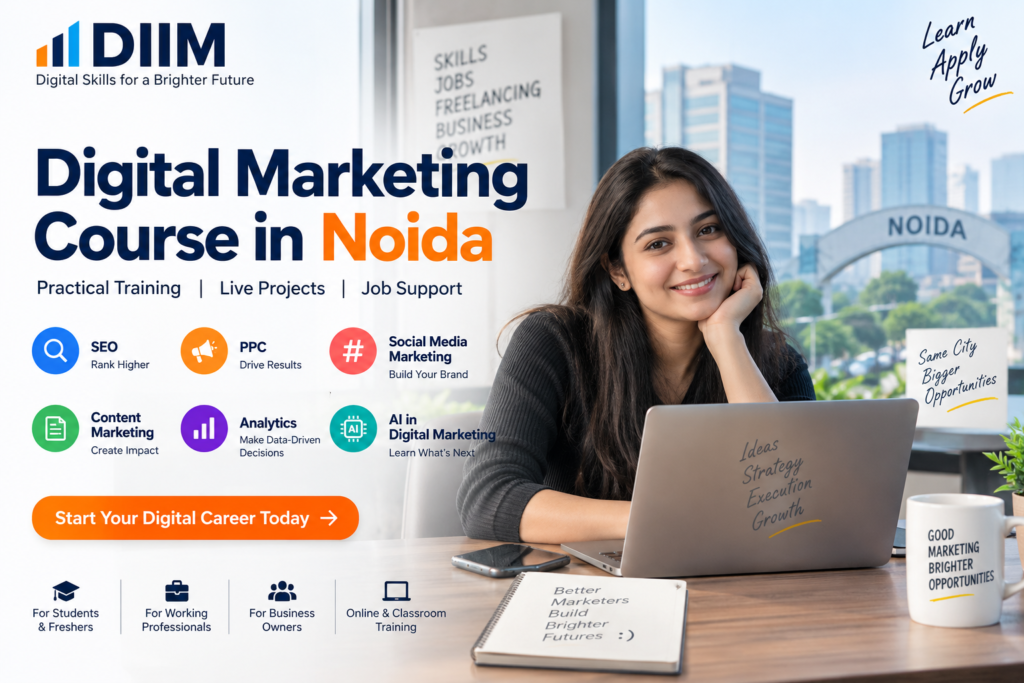
Digital marketing has become an important skill for businesses, startups, freelancers, and job seekers. A good Digital Marketing Course in Noida can help learners understand how websites, search engines, social media, online advertising, content, analytics, and AI tools work together.
Instead of learning only theory, students can focus on practical skills such as SEO, Google Ads, social media marketing, content marketing, email marketing, analytics, and AI-powered digital marketing. Practical assignments and live project experience can also help students understand how these skills are used in real business situations.
Why Learn Digital Marketing in Noida?
Noida is a major business and technology hub in the Delhi-NCR region. Many companies, agencies, startups, e-commerce businesses, and service brands use digital channels to reach customers.
This creates opportunities for people who want to build skills in online marketing.
A structured Digital Marketing Training in Dubai can help beginners learn step by step instead of trying to understand different tools on their own.
What Can You Learn?
A complete course may cover:
- Search Engine Optimization (SEO)
- Google Ads and PPC
- Social Media Marketing
- Content Marketing
- Email Marketing
- Google Analytics
- Website basics
- Lead generation
- E-commerce marketing
- AI tools for marketing
- Online reputation and brand promotion
The exact syllabus can vary between institutes, so students should check the modules, practical sessions, trainer experience, projects, and placement support before joining.
What Is Covered in a Digital Marketing Course?
A useful course should cover both fundamental concepts and practical applications. The goal is not simply to remember definitions but to understand how different digital marketing channels work together.
Search Engine Optimization
SEO helps businesses improve their visibility in search engine results.
Students can learn:
- Keyword research
- On-page SEO
- Technical SEO basics
- Content optimization
- Internal linking
- Off-page SEO
- Local SEO
- SEO tools
- Search performance analysis
SEO is useful for websites, blogs, local businesses, e-commerce stores, and service companies.
Google Ads and PPC
Paid advertising is another important part of digital marketing.
Students can learn about:
- Search campaigns
- Keyword selection
- Ad copy
- Landing pages
- Conversion tracking
- Campaign structure
- Negative keywords
- Remarketing
- Performance analysis
Practical campaign exercises can make it easier to understand how paid advertising works.
Social Media Marketing
Social media allows businesses to communicate directly with their audience.
Training may include:
- Facebook marketing
- Instagram marketing
- Social media strategy
- Content planning
- Reels and creative content
- Audience research
- Social media advertising
- Campaign analysis
Students can learn how to create a content plan based on a business goal rather than simply posting random content.
Content Marketing
Content is an important part of SEO and brand communication.
Students can learn how to create:
- Website content
- Blog articles
- Social media posts
- Landing page content
- Product descriptions
- Promotional content
- Educational content
Good content should provide useful information while matching the search intent of the audience.
Email Marketing
Email marketing can help businesses communicate with existing customers and leads.
A course may introduce:
- Email campaign planning
- Subscriber lists
- Newsletter creation
- Lead nurturing
- Automation
- Open and click analysis
Analytics and Reporting
Marketing decisions should be based on data.
Students can learn how to understand:
- Website traffic
- User behaviour
- Campaign performance
- Leads
- Conversions
- Engagement
- ROI-related metrics
Analytics helps marketers identify what is working and what needs improvement.
How Practical Training Helps Students
Digital marketing is easier to understand when students work on real examples.
During Digital Marketing Classes in Noida, practical activities may include creating a basic website strategy, researching keywords, preparing SEO content, setting up sample advertising campaigns, creating social media calendars, and analysing campaign data.
Practical Learning Can Include
- Keyword research exercises
- SEO audits
- Website optimization
- Content writing assignments
- Social media campaigns
- Google Ads practice
- Analytics reporting
- Lead-generation exercises
- AI tool demonstrations
- Live project work
The purpose of practical training is to help students understand the complete workflow from planning to execution and reporting.
How to Choose a Digital Marketing Institute in Noida
Choosing the right Digital Marketing Institute in Noida requires more than checking the course name.
Before enrolling, compare:
| Factor | What to Check |
|---|---|
| Syllabus | Are important digital marketing modules included? |
| Practical Training | Are students given hands-on assignments? |
| Trainer | Does the trainer have practical industry experience? |
| Projects | Are live or project-based activities included? |
| Tools | Will students work with commonly used marketing tools? |
| Career Support | Is interview and placement assistance available? |
| Class Format | Classroom, online, or hybrid options |
| Doubt Support | Can students get individual guidance? |
| Certification | What type of course certificate is provided? |
A transparent institute should clearly explain the curriculum, duration, training method, projects, fees, and career support before admission.
Who Can Join a Digital Marketing Course?
Digital marketing does not require a specific academic background.
The course can be useful for:
- College students
- Fresh graduates
- Job seekers
- Working professionals
- Business owners
- Entrepreneurs
- Freelancers
- Bloggers
- E-commerce sellers
- People planning a career change
Basic computer knowledge and an interest in online marketing are generally enough to begin.
Digital Marketing for Freshers
Freshers can use digital marketing skills to build an entry-level career.
Depending on their skills and experience, they may explore roles such as:
- SEO Executive
- Digital Marketing Executive
- Social Media Executive
- PPC Executive
- Content Marketing Executive
- SEO Content Writer
- Performance Marketing Executive
- Email Marketing Executive
- Digital Marketing Intern
For freshers, practical work can be particularly useful because employers may look at skills, projects, communication, and problem-solving ability along with academic qualifications.
Skills You Should Build Along With the Course
Completing a course is only one part of becoming a digital marketer.
Students should also develop:
Communication Skills
Digital marketers regularly communicate with clients, team members, designers, developers, and customers.
Analytical Thinking
Marketing involves numbers, reports, testing, and performance analysis.
Content Skills
The ability to explain ideas clearly is useful for SEO, social media, blogs, advertisements, and websites.
Creativity
Creative thinking helps with content ideas, campaigns, advertisements, and brand communication.
Problem-Solving
Campaigns do not always perform as expected. Marketers need to identify problems and test possible solutions.
Career Opportunities After Digital Marketing Training
Digital marketing offers different career paths depending on the skills a learner develops.
Some people focus on SEO, while others move towards paid advertising, social media, content, analytics, e-commerce, or broader digital marketing roles.
A learner can gradually specialise after understanding the fundamentals.
For example:
Digital Marketing Basics → Practical Projects → Specialisation → Portfolio → Job/Freelancing
Building a portfolio with actual assignments and project examples can also help demonstrate practical knowledge during interviews.
Can You Learn Digital Marketing With AI?
Yes. AI tools are increasingly being used across digital marketing workflows.
AI can support tasks such as:
- Content research
- Content ideas
- Keyword analysis
- Ad copy variations
- Social media ideas
- Data analysis
- Competitor research
- Workflow automation
- Customer communication
However, AI should be treated as a supporting tool. Marketers still need to understand search intent, customers, brand messaging, campaign strategy, data, and quality control.
That is why modern Digital Marketing Training in Noida can benefit from including AI tools alongside traditional marketing concepts.
Digital Marketing Course Duration
Course duration depends on the institute, syllabus, class schedule, and level of training.
Short-term courses may focus on selected modules, while comprehensive programs can cover multiple channels along with practical projects.
Before joining, check whether the advertised duration includes:
- Complete syllabus
- Practical assignments
- Projects
- Doubt sessions
- Tool training
- Assessment
- Career support
A longer course is not automatically better. The depth and quality of practical learning matter as well.
Digital Marketing Course Fees in Noida
The cost of a Digital Marketing Course in Noida can vary depending on the institute, course duration, syllabus, trainer experience, practical training, projects, certification, and career support.
Instead of comparing only the fee, students should compare the complete course value.
Ask the institute about:
- Total course fee
- Payment options
- Course duration
- Modules included
- Practical sessions
- Projects
- Certification
- Placement assistance
- Additional tool or training charges
This gives a clearer picture of what the course actually provides.
Is Digital Marketing a Good Skill for Career Growth?
Digital marketing combines several areas, including technology, communication, creativity, advertising, data, and business.
This makes it possible for learners to move in different directions over time.
Someone starting with SEO may later learn paid advertising. A content writer may move into content strategy. A social media executive may develop performance marketing skills.
The important part is continuous learning because digital platforms, tools, search behaviour, and advertising systems keep changing.
A Simple Learning Path for Beginners
If you are completely new to digital marketing, avoid trying to learn everything at once.
Follow a structured path:
Step 1: Understand digital marketing fundamentals
↓
Step 2: Learn SEO and content
↓
Step 3: Understand social media marketing
↓
Step 4: Learn Google Ads and paid marketing
↓
Step 5: Study analytics and reporting
↓
Step 6: Use AI tools in your workflow
↓
Step 7: Complete practical projects
↓
Step 8: Build a portfolio
↓
Step 9: Apply for jobs, internships, or freelance projects
This approach gives beginners a clear direction and allows them to build skills gradually.
Why Practical Projects Matter
A certificate can show that you completed a course, but a project can demonstrate what you can actually do.
A strong portfolio may include:
- SEO audit
- Keyword research report
- Optimized blog
- Social media content plan
- Google Ads campaign structure
- Landing page analysis
- Analytics report
- Lead-generation campaign plan
These projects can also become useful talking points during interviews.
Final Thoughts
Choosing a Digital Marketing Course in Noida can be a practical way to develop skills in SEO, paid advertising, social media, content, analytics, and AI-powered marketing.
The most important thing is to focus on practical training, experienced guidance, real project work, updated tools, and career-oriented learning rather than choosing a course only because of its name or certificate.
For beginners, a structured learning path can make digital marketing easier to understand and can provide a foundation for exploring jobs, freelancing, business promotion, or further specialisation.
Frequently Asked Questions
1. What is a Digital Marketing Course in Noida?
It is a structured training program that teaches online marketing skills such as SEO, Google Ads, social media marketing, content marketing, analytics, email marketing, and AI tools.
2. Can beginners join a digital marketing course?
Yes. Beginners can start with basic digital marketing concepts and gradually move towards advanced tools and practical projects.
3. Is digital marketing useful for freshers?
Digital marketing can provide freshers with several skill-based career paths, including SEO, social media, content, PPC, and digital marketing executive roles.
4. What is taught in digital marketing training?
Training commonly includes SEO, PPC, social media, content marketing, email marketing, analytics, lead generation, e-commerce marketing, and AI tools.
5. Do digital marketing courses include practical training?
This depends on the institute. Students should check whether the course includes assignments, projects, campaign practice, audits, and reporting exercises.
6. Can I learn digital marketing after graduation?
Yes. Digital marketing can be learned after graduation regardless of the student’s academic stream.
7. Can business owners learn digital marketing?
Yes. Business owners can learn digital marketing to understand SEO, social media, advertising, content, lead generation, and online customer acquisition.
8. Can digital marketing be used for freelancing?
Yes. Skills such as SEO, content marketing, social media management, PPC, and website marketing can be offered as freelance services.
9. Does digital marketing include AI?
Modern digital marketing workflows can use AI for research, content ideation, analysis, automation, advertising support, and other tasks.
10. How should I choose a digital marketing institute?
Compare the syllabus, practical training, trainers, projects, tools, class format, career support, certification, and overall course structure before enrolling.