
Digital marketing has become an important skill for businesses, brands, students and working professionals. Today, companies use search engines, websites, social media, online advertising and useful content to connect with customers.
Because of this growth, many students, freshers and professionals are exploring a Digital Marketing Course in Delhi to learn practical online marketing skills and understand how businesses attract customers through digital channels.
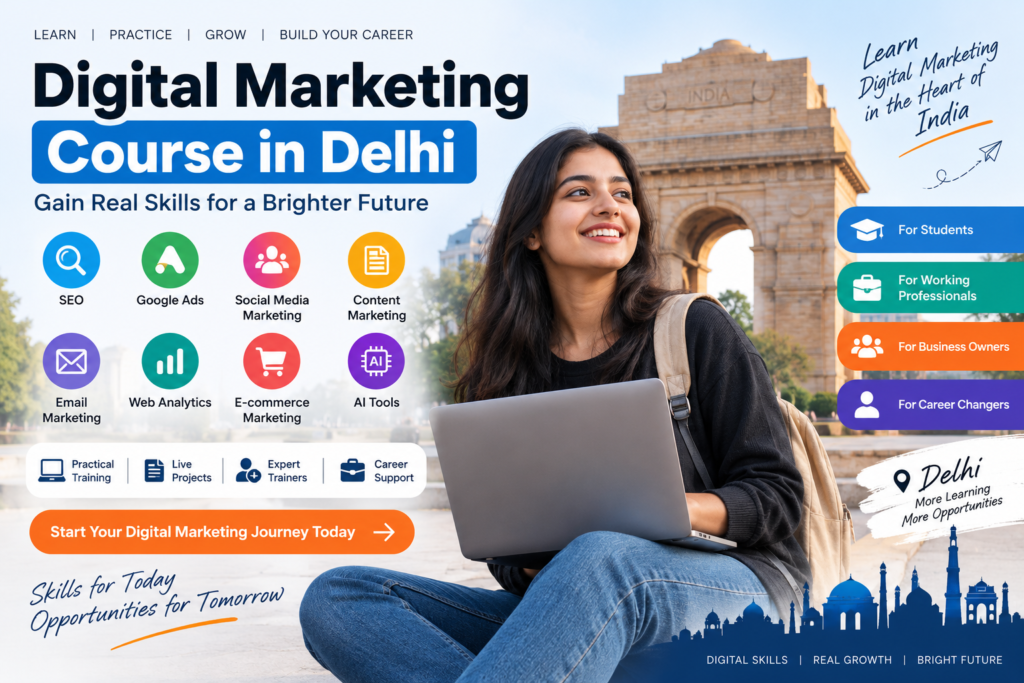
A well-structured course can introduce learners to SEO, Google Ads, social media marketing, content marketing, email marketing, web analytics, lead generation and AI tools for digital marketing. These skills can be useful for both employment and freelance work.
However, selecting a course should not be based only on its name or certificate. Before joining, it is important to understand the digital marketing course syllabus, practical training, trainer experience, projects, learning support, course duration and digital marketing course fees in Delhi.
This guide explains the major topics, skills, training options and career paths you should understand before choosing digital marketing training in Delhi.
What Is Digital Marketing?
Digital marketing is the process of promoting a business, product or service through online platforms. It helps businesses reach people through search engines, websites, social media, email, online advertising and other digital channels.
For example, a company may use search engine optimization (SEO) to attract organic visitors from Google. It may use PPC advertising to reach potential customers through paid campaigns. Social media can help the business communicate with its audience and build awareness.
Some common digital marketing channels include:
- Google Search
- Business websites
- Social media platforms
- Online advertising
- Email marketing
- Blogs and articles
- Videos
- E-commerce platforms
The main purpose is to reach the right audience and support goals such as website traffic, lead generation, enquiries, conversions and sales.
Learning these basic concepts is the first step for anyone interested in a digital marketing career.
Why Are People Learning Digital Marketing in Delhi?
Delhi has a large business environment with companies, startups, agencies, educational organisations, service businesses and e-commerce brands. Many of these businesses use digital channels to reach customers and promote their products or services.
This has increased interest in digital marketing training in Delhi among students, freshers and working professionals. Some people want to enter the marketing industry, while others want to develop skills that can support their existing profession or business.
People may explore a Digital Marketing Course in Delhi for several reasons:
- Start a digital marketing career
- Learn a new professional skill
- Explore a career change
- Prepare for entry-level digital marketing jobs
- Start freelancing
- Promote a business online
- Learn SEO and paid advertising
- Manage websites and social media
- Understand modern digital marketing strategies
Different learners have different goals. A student may want job-ready skills, while a business owner may want to understand online promotion. Identifying your goal first can help you select suitable digital marketing classes in Delhi.
What Does a Digital Marketing Course in Delhi Teach?
A digital marketing course usually introduces learners to several areas of online marketing. The exact digital marketing course syllabus can vary between training providers, so it is useful to compare the topics before joining.
A comprehensive course may cover:
- Search Engine Optimization (SEO)
- Google Ads and PPC advertising
- Social Media Marketing
- Content Marketing
- Email Marketing
- Website Marketing
- E-commerce Marketing
- Local SEO
- Lead Generation
- Web Analytics
- Conversion Tracking
- AI Tools for Digital Marketing
Learning these areas together gives beginners a better understanding of how different marketing channels work together. For example, SEO can bring organic traffic, paid campaigns can generate targeted visits, and content can help educate potential customers.
When comparing a digital marketing institute in Delhi, check whether the syllabus explains both the basic concepts and the practical use of these channels.
What Are the Main Modules in Digital Marketing?
A digital marketing course normally includes several modules because online marketing involves different skills. Each module focuses on a particular part of the marketing process, from attracting visitors to measuring conversions.
1. Search Engine Optimization
Search Engine Optimization (SEO) helps websites improve their visibility in organic search results. It is an important part of many digital marketing training programs because businesses often depend on search traffic to reach potential customers.
Students may learn:
- Keyword research
- Search intent
- On-page SEO
- Technical SEO basics
- Content optimisation
- Internal linking
- Local SEO
- Competitor research
- Website audits
A learner interested in SEO training in Delhi should understand that SEO involves more than adding keywords to a webpage. It also includes content quality, website structure, search intent and technical factors.
SEO can help businesses attract relevant organic website traffic over time.
2. Google Ads and PPC
Google Ads is a paid advertising platform that allows businesses to show advertisements when people search for relevant products or services. PPC stands for Pay-Per-Click, a common advertising model where advertisers can be charged based on clicks.
A digital marketing course may teach:
- Keyword research
- Search campaigns
- Ad creation
- Audience targeting
- Location targeting
- Budget management
- Conversion tracking
- Campaign analysis
- PPC campaign optimisation
Good Google Ads training should also explain how campaign performance is measured. Students can practise reading data, identifying relevant keywords and understanding how changes can affect campaign results.
Practical exercises can make concepts such as paid search advertising and PPC advertising easier to understand.
3. Social Media Marketing
Social Media Marketing helps businesses communicate with their audiences through platforms such as Instagram, Facebook, LinkedIn and YouTube.
A social media marketing course may cover:
- Content planning
- Social media strategy
- Audience research
- Post planning
- Community engagement
- Social media advertising
- Performance tracking
Learners can understand how businesses use social media platforms to share content, communicate with customers and build brand awareness.
Practical work can include creating a content calendar, planning posts and reviewing social media performance.
4. Content Marketing
Content marketing focuses on creating useful and relevant information for a particular audience. Content can help answer questions, explain products, educate customers and support other marketing activities.
Content marketing may include:
- Blog posts
- Website pages
- Social media content
- Videos
- Guides
- Email content
- SEO content
Good content should match the user’s search intent and provide useful information. It should not be created simply to insert keywords.
Learning content marketing can therefore help students understand how useful content supports SEO, social media, lead generation and customer communication.
5. Email Marketing
Email marketing helps businesses communicate with existing and potential customers. It can be used for newsletters, product information, updates, educational content and customer communication.
Students may learn about:
- Email campaigns
- Newsletters
- Email lists
- Customer communication
- Campaign reports
- Email performance
This skill can be useful for e-commerce marketing, service businesses and online brands because email can help businesses communicate with people who have already shown interest.
6. Web Analytics
Web analytics helps marketers understand website activity and evaluate marketing performance. Instead of relying only on assumptions, marketers can use data to understand what is happening on a website.
Students may learn how to analyse:
- Website visitors
- Traffic sources
- User behaviour
- Leads
- Conversions
- Campaign performance
- Marketing data
A course may also introduce conversion tracking, which helps marketers understand whether website visitors complete important actions such as enquiries, registrations or purchases.
Analytics is an important part of modern digital marketing strategies because it connects marketing activity with measurable results.
7. AI for Digital Marketing
AI-powered digital marketing is becoming part of many modern marketing workflows. AI tools can support research, planning, content ideas, data analysis and repetitive tasks.
AI can assist with activities such as:
- Topic research
- Content ideas
- Keyword analysis
- Content planning
- Data analysis
- Marketing automation
- Repetitive tasks
Learning AI tools for digital marketing can help students understand how marketers are using technology in their daily work.
However, AI-generated output still needs human review. Marketers need to check facts, quality, originality, audience needs and business goals before using the output.
Why Is Practical Training Important?
Digital marketing is a practical field. Reading about SEO, Google Ads or social media can help you understand the theory, but applying those concepts to actual tasks can provide a different type of learning experience.
For example, knowing what keyword research means is different from researching keywords for a website, grouping them by search intent and using them to create a content plan.
Practical digital marketing training may include:
- Website projects
- SEO tasks
- Keyword research
- Content planning
- Advertising campaign exercises
- Social media projects
- Analytics practice
- Conversion tracking
Projects can also help learners build examples of their work. These examples may be useful when preparing a portfolio or discussing practical skills during interviews.
If you are comparing different training options, our guide on how to choose the best digital marketing course explains several factors to consider before joining a course.
How Should You Choose a Digital Marketing Course in Delhi?
Choosing a course requires more than comparing the course fee or certificate. You should understand what the course teaches, how the training is delivered and what kind of practical support is available.
When comparing a digital marketing institute in Delhi, consider the following areas.
Check the Course Syllabus
The syllabus should cover important areas such as SEO, Google Ads, social media marketing, content marketing, analytics, email marketing and AI tools.
You should also check whether the digital marketing course syllabus includes practical topics such as keyword research, campaign setup, conversion tracking and reporting.
An updated syllabus can help learners understand current marketing tools and practices.
Check Practical Training
Ask whether students get assignments, exercises and projects during the course. Practical work can help turn theoretical knowledge into usable skills.
Look for training where learners get opportunities to practise SEO, paid advertising, social media, analytics and content marketing rather than only watching demonstrations.
Check Trainer Experience
Trainer experience can affect how easily difficult topics are explained. A good trainer should be able to connect concepts with practical marketing examples.
Before joining digital marketing classes in Delhi, check the trainer’s background, teaching approach and experience with the subjects being taught.
Check Learning Support
Learning digital marketing can involve questions about tools, campaigns, websites and analytics. Ask whether learners can get help when they face difficulties during assignments or projects.
Regular guidance can make the learning process easier, especially for beginners.
Check Projects
Projects give learners an opportunity to apply their knowledge. Ask what type of live projects or practical projects are included.
You can also ask whether students work with websites, SEO tasks, advertising campaigns, social media content or analytics data.
Check Career Support
If your main goal is employment, check whether the institute provides career guidance, interview preparation, resume support or portfolio development.
Also understand exactly what is included in the career support instead of relying only on broad placement-related claims.
Who Can Join a Digital Marketing Course?
Digital marketing can be learned by people from different educational and professional backgrounds. You do not necessarily need a technical degree to understand the basic concepts of online marketing.
A digital marketing course for beginners can be useful for:
- Students
- College graduates
- Freshers
- Working professionals
- Business owners
- Entrepreneurs
- Freelancers
- Career changers
Basic computer knowledge and a willingness to practise can help you get started.
People who already have skills in sales, writing, design, business or technology may also find ways to connect their existing experience with new digital marketing skills.
Can Freshers Get Digital Marketing Jobs?
Freshers can apply for entry-level digital marketing positions after developing relevant skills and gaining some practical experience. The first role can provide an opportunity to learn how marketing teams manage websites, campaigns, content and reporting.
Common entry-level roles include:
- Digital Marketing Executive
- SEO Executive
- Social Media Executive
- Content Executive
- PPC Executive
- Email Marketing Executive
However, completing a digital marketing certification course does not by itself demonstrate everything a candidate can do.
Employers may also consider practical knowledge, project experience, communication skills and portfolio work. For this reason, students should try to build practical examples while completing their training.
What Skills Should You Learn for a Digital Marketing Career?
A successful digital marketer uses a combination of technical, creative, analytical and communication skills. You do not need to master everything immediately, but a strong foundation can help you understand how different marketing activities connect.
SEO Skills
You should understand keyword research, search intent, on-page SEO, content optimisation, internal linking and basic technical SEO.
These skills can help you understand how websites are structured and how content can be improved for users and search engines.
Paid Advertising Skills
You should understand Google Ads, PPC campaigns, audience targeting, ad copy, budgets, conversion tracking and campaign analysis.
These skills are useful when working with paid advertising campaigns and measuring their performance.
Social Media Skills
You should understand social media strategy, content planning, audience research, engagement and social media analytics.
These skills can help you plan content and understand how audiences interact with social platforms.
Content Skills
You should know how to create clear and useful content that answers customer questions and supports business objectives.
Basic knowledge of content marketing can also help you work with blogs, website pages, social media content and other marketing formats.
Analytics Skills
You should learn how to understand website traffic, leads, conversions and marketing performance data.
Knowledge of web analytics and conversion tracking can help marketers understand which activities are producing useful results.
Communication Skills
Digital marketers often work with clients, business owners, designers, developers, sales teams and other marketers.
Clear communication can therefore be an important professional skill, especially when explaining campaign results or discussing project requirements.
Problem-Solving Skills
Marketing campaigns do not always produce the expected results. A marketer needs to identify the issue, study the available data and test possible solutions.
This makes problem-solving an important part of practical digital marketing training.
AI Skills
Learning AI tools for digital marketing can support research, planning, content ideas, analysis and repetitive work.
The important skill is not only knowing how to use an AI tool but also knowing how to review its output and connect it with a real marketing objective.
What Career Opportunities Are Available After Digital Marketing Training?
Digital marketing has several career paths. A learner can begin with a general role and later develop specialist skills in an area that matches their interests and experience.
Some common digital marketing career options include:
- Digital Marketing Executive
- SEO Executive
- SEO Specialist
- PPC Executive
- Google Ads Specialist
- Social Media Marketing Executive
- Content Marketing Executive
- Performance Marketing Specialist
- Digital Marketing Analyst
- E-commerce Marketing Executive
The exact role can depend on a person’s skills, experience, portfolio and the requirements of the employer.
If you want to understand the broader career landscape, you can also read our guide to digital marketing career opportunities in Chandigarh.
Can You Do Freelancing After Learning Digital Marketing?
Digital marketing skills can also be used for freelance work. Freelancers may work with different businesses and provide specific services based on their knowledge and experience.
A freelancer may offer:
- SEO
- Local SEO
- Google Ads
- Social media management
- Content writing
- Website optimisation
- Lead generation
- Email marketing
- Analytics and reporting
For example, someone with strong local SEO skills may help local businesses improve their online visibility, while someone with PPC knowledge may manage paid advertising campaigns.
However, freelancing requires more than marketing knowledge. You also need client communication, project management, pricing, reporting and time management skills.
A portfolio can help demonstrate your work and explain your services to potential clients.
Can Business Owners Learn Digital Marketing?
Business owners can learn digital marketing to understand how their businesses can reach customers online. These skills can also help them communicate more effectively with marketing teams, freelancers or agencies.
For example, a business owner may learn:
- Local SEO
- Google Ads
- Social media marketing
- Website marketing
- Content marketing
- Lead generation
- Analytics
Understanding online marketing strategies can help business owners make more informed decisions about their website, advertising, content and customer acquisition activities.
A business owner does not necessarily need to become a full-time marketer. Even basic knowledge can make it easier to understand how different digital channels work.
Online vs Classroom Digital Marketing Training
Digital marketing can be learned through classroom sessions, online learning or a combination of both. The right format can depend on your schedule, learning preferences and need for direct interaction.
Online Learning
An online digital marketing course can provide:
- Flexible learning
- Remote access
- Recorded lessons
- Learning from home
- Flexible schedules
Online learning can be useful for people who need to manage studies, work or other responsibilities alongside their training.
Classroom Learning
Classroom digital marketing classes in Delhi can provide:
- Direct interaction with trainers
- Face-to-face discussions
- Immediate questions and answers
- Classroom activities
- Interaction with other learners
Some learners prefer classroom training because they can discuss questions directly with the trainer and other students.
The important point is to choose a learning format that allows you to understand the concepts and practise the skills regularly.
How Long Does It Take to Learn Digital Marketing?
The time needed to learn digital marketing depends on the course structure, study schedule and amount of practical work. Digital marketing includes many subjects, so learning the basics is different from becoming job-ready.
A learner should focus on:
- Understanding the basics
- Practising each skill
- Working on projects
- Building a portfolio
- Learning marketing tools
- Improving communication
- Preparing for interviews
The learning period can also depend on whether you are studying full-time, part-time or through an online digital marketing course.
Regular practice is important because digital marketing skills improve through application, not only through reading or watching lessons.
What Should You Check Before Joining a Digital Marketing Course?
Before joining a course, compare the important details instead of looking at only one factor. This is especially useful when comparing digital marketing course fees in Delhi, because a lower or higher fee does not by itself explain the quality or practical value of a course.
Check:
- Digital marketing course syllabus
- Practical training
- Live or realistic projects
- Trainer experience
- Marketing tools covered
- AI training
- Assignments
- Portfolio support
- Interview preparation
- Learning support
- Course duration
- Digital marketing course fees in Delhi
- Available reviews and course information
- Certification details
You can also check whether the digital marketing certification course includes an assessment, project work or simply provides a certificate after completing the training.
Do not compare courses only by price. Understand what is included in the training and what practical experience you will receive.
Can Digital Marketing Help With a Career Change?
Digital marketing can be explored by professionals from many backgrounds. Some people may already have skills that can be useful in online marketing.
For example:
A sales professional may understand customers and lead generation.
A content writer may already have strong writing skills.
A designer may understand visual communication.
An IT professional may already understand websites and technology.
By combining existing professional experience with digital marketing skills, a person can explore different roles within the marketing field.
The transition can be easier when learners focus on practical projects and choose digital marketing areas that connect with their previous experience.
How AI Is Changing Digital Marketing Careers
AI is changing many marketing tasks and workflows. Marketers can use AI tools to support research, content planning, data analysis and repetitive activities.
For example, AI can help with:
- Topic research
- Content ideas
- Audience research
- Marketing planning
- Data analysis
- Workflow automation
- Repetitive tasks
Modern AI tools for digital marketing can save time on certain activities, but marketers still need to understand customers, business objectives and marketing strategy.
Human review is also important for checking accuracy, quality, originality and relevance.
Learning how to combine AI with digital marketing skills can help learners understand the changing tools and workflows used in modern marketing.
How Can You Start Learning Digital Marketing?
Starting with the basics can make digital marketing easier to understand. Begin by learning how SEO, paid advertising, social media, content marketing and analytics work.
After understanding the fundamentals, choose the areas that match your interests. You can then practise those skills through website work, content projects, advertising exercises or analytics tasks.
If you are comparing training options, look at the syllabus, trainer experience, practical work, projects and learning support before making a decision.
If you are also considering options outside Delhi, you can explore practical digital marketing training in Chandigarh to understand a different course structure and approach to hands-on learning.
Final Thoughts
A Digital Marketing Course in Delhi can help students, freshers, professionals, freelancers and business owners develop useful online marketing skills.
The field covers many areas, including SEO, Google Ads, social media marketing, content marketing, email marketing, web analytics, e-commerce marketing, lead generation and AI-powered marketing.
Before joining a course, look beyond the certificate and compare the digital marketing course syllabus, practical training, projects, trainer experience, tools, learning support and career preparation.
Also consider the overall value of the course rather than looking only at digital marketing course fees in Delhi.
Most importantly, practise what you learn. Digital marketing is a practical field, and the ability to apply your knowledge to real tasks can help you build stronger skills over time.
Frequently Asked Questions
1. What is a Digital Marketing Course in Delhi?
A Digital Marketing Course in Delhi teaches learners how businesses use online channels such as search engines, websites, social media, email and paid advertising to reach customers. Depending on the course, students may learn SEO, Google Ads, content marketing, analytics, social media and AI tools.
2. Who can join a digital marketing course in Delhi?
Students, graduates, freshers, working professionals, business owners, freelancers and career changers can learn digital marketing. A digital marketing course for beginners can provide the basic concepts needed to start learning the field.
3. What is included in a digital marketing course syllabus?
A digital marketing course syllabus may include SEO, Google Ads, PPC advertising, social media marketing, content marketing, email marketing, web analytics, local SEO, e-commerce marketing, lead generation, conversion tracking and AI tools.
4. What should I check before choosing a digital marketing institute in Delhi?
Before selecting a digital marketing institute in Delhi, check the syllabus, practical training, trainer experience, projects, learning support, tools covered, course duration, certification and career support. It is also useful to understand exactly what is included in the training.
5. How much are digital marketing course fees in Delhi?
Digital marketing course fees in Delhi can vary between training providers depending on course duration, modules, training format, practical work, projects and additional support. Instead of comparing price alone, check what is included in the course.
6. Are digital marketing classes in Delhi available for beginners?
Yes. Many digital marketing classes in Delhi can be designed for beginners. Learners can start with basic concepts such as SEO, social media, content and paid advertising before moving to more advanced topics.
7. Is practical training important in a digital marketing course?
Yes. Practical digital marketing training allows learners to apply concepts through assignments, website work, SEO exercises, advertising practice, content projects and analytics tasks. This can help connect theory with real marketing activities.
8. Can freshers get digital marketing jobs after completing a course?
Freshers can apply for entry-level digital marketing jobs after developing relevant skills and practical experience. Roles may include Digital Marketing Executive, SEO Executive, PPC Executive, Social Media Executive and Content Executive.
9. Can I learn digital marketing through an online course?
Yes. An online digital marketing course can provide access to lessons from home and may offer flexible schedules or recorded learning. The quality of the learning experience can depend on the course structure, trainer support and practical assignments.
10. Can I become a freelancer after learning digital marketing?
Yes. Learners can develop freelance services in areas such as SEO, local SEO, Google Ads, social media management, content marketing, lead generation and analytics. Along with marketing knowledge, freelancers need communication, pricing, reporting and project management skills.
11. Is a digital marketing certification course enough to get a job?
A digital marketing certification course can document that you completed training, but a certificate alone does not demonstrate every practical skill. Project experience, portfolio work, communication and knowledge of marketing tools can also be important when applying for jobs.
12. Is AI useful for digital marketing?
Yes. AI tools for digital marketing can support research, content planning, data analysis, audience research and repetitive tasks. Marketers still need to review AI output and make decisions based on customers, business goals and marketing strategy.