
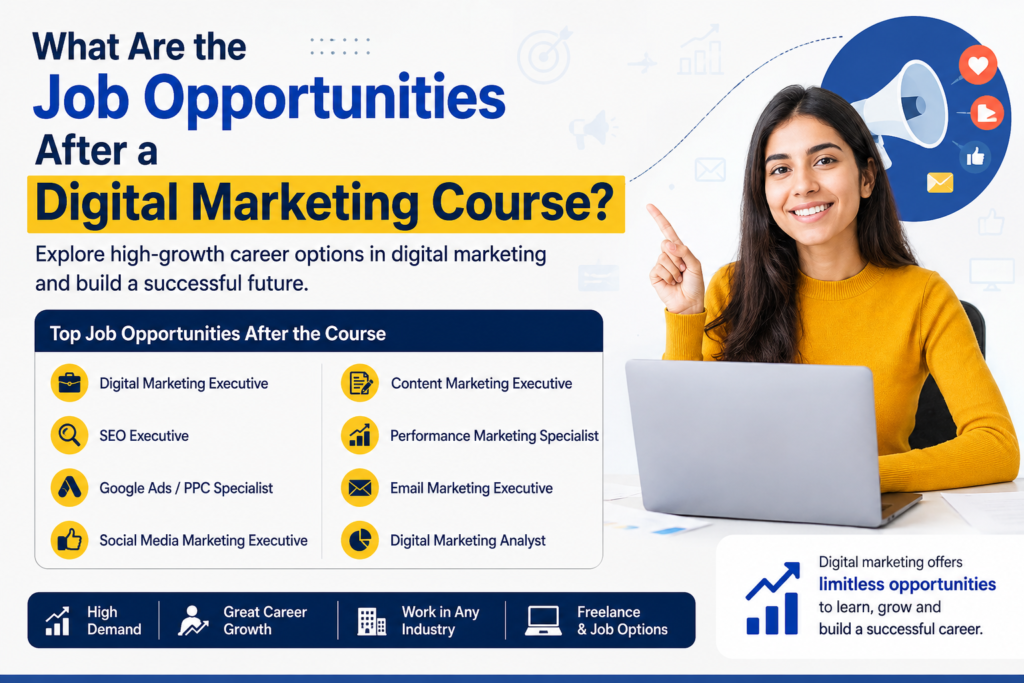
Digital marketing has become an important part of modern business. Companies use websites, search engines, social media, online advertising, email and content to reach their customers.
As more businesses move online, they need people who understand how digital marketing works. This has created many career options for students, freshers, working professionals and people who want to change their careers.
If you are thinking about learning digital marketing, you may be wondering about the job opportunities after a digital marketing course. You may also want to know which roles are available, what skills employers look for and whether you can start your career without previous experience.
The good thing is that digital marketing has many different areas. You can start with basic knowledge and later specialise in SEO, paid advertising, social media, content, analytics, performance marketing or e-commerce.
What Can You Do After a Digital Marketing Course?
A digital marketing course can introduce you to different areas of online marketing.
After learning the basics and gaining practical experience, you can explore roles such as:
- Digital Marketing Executive
- SEO Executive
- SEO Specialist
- Google Ads or PPC Executive
- Social Media Marketing Executive
- Content Marketing Executive
- Email Marketing Executive
- Performance Marketing Specialist
- Digital Marketing Analyst
- E-commerce Marketing Executive
You do not need to choose every area at the same time.
You can first learn the basics of digital marketing and then choose a specialisation based on your interests, skills and career goals.
Why Are Digital Marketing Jobs Growing?
People spend a large part of their daily lives online. They use Google to search for products, social media to discover brands, websites to compare services and online stores to make purchases.
Businesses want to reach these customers through the right digital channels.
For example, a company may use:
- SEO to get visitors from Google
- Google Ads to reach people searching for its services
- Social media to connect with its audience
- Content marketing to answer customer questions
- Email marketing to stay connected with customers
- Analytics to understand campaign results
- Conversion optimisation to improve leads and sales
These activities need people who understand digital marketing tools and strategies.
This is one reason why there are different digital marketing career opportunities across agencies, startups, e-commerce companies, service businesses and established organisations.
What Jobs Can You Get After a Digital Marketing Course?
One of the main benefits of digital marketing is that it offers different types of job roles.
You can work as a general digital marketing professional or focus on one specific area as you gain more experience.
1. Digital Marketing Executive
A Digital Marketing Executive usually works on different online marketing activities.
The exact responsibilities depend on the company, but the role may include:
- SEO
- Social media marketing
- Content marketing
- Google Ads
- Email marketing
- Website promotion
- Lead generation
- Basic analytics
- Campaign reporting
This can be a useful starting role for beginners because it allows them to understand different parts of digital marketing.
2. SEO Executive
SEO stands for Search Engine Optimization.
An SEO Executive works on improving a website’s visibility in organic search results.
The work may include:
- Keyword research
- Search intent analysis
- On-page SEO
- Content optimisation
- Internal linking
- Local SEO
- Competitor research
- Website audits
- Search performance tracking
SEO can be a good career option if you enjoy websites, Google search, research and content.
3. Google Ads or PPC Executive
PPC stands for Pay-Per-Click.
A PPC professional manages paid advertising campaigns to help businesses reach potential customers.
The work may include:
- Keyword research
- Campaign setup
- Ad copy
- Audience targeting
- Location targeting
- Budget management
- Conversion tracking
- Campaign reporting
- Performance optimisation
This role can suit people who enjoy numbers, testing, advertising and campaign performance.
4. Social Media Marketing Executive
Social media is an important marketing channel for many businesses.
A Social Media Marketing Executive helps a company build and manage its presence on platforms such as Instagram, Facebook, LinkedIn and YouTube.
The responsibilities may include:
- Content planning
- Social media calendars
- Post ideas
- Caption writing
- Audience research
- Community engagement
- Campaign coordination
- Performance reporting
Social media marketing is not only about creating attractive posts. You also need to understand the audience, business goals and performance data.
5. Content Marketing Executive
Content marketing uses useful information to attract and educate potential customers.
A Content Marketing Executive may work on:
- Blog posts
- Website pages
- Social media content
- Email content
- Landing pages
- Content calendars
- Content research
- SEO content
This can be a good career path for people who enjoy writing, research and communication.
Good content should answer the user’s question and provide real value instead of simply adding keywords to a page.
6. Email Marketing Executive
Email marketing helps businesses communicate directly with their customers.
An Email Marketing Executive may work on:
- Email campaigns
- Newsletters
- Promotional emails
- Customer lists
- Email content
- Campaign reports
- Open and click rates
Email marketing is commonly used by e-commerce businesses, service companies, educational businesses and many other brands.
7. Performance Marketing Specialist
Performance marketing focuses on measurable business results.
These results may include:
- Leads
- Sales
- Enquiries
- Website visits
- App downloads
- Conversions
A Performance Marketing Specialist may manage advertising campaigns, audiences, landing pages and conversion tracking.
This role often requires knowledge of paid advertising, analytics, testing and campaign optimisation.
It can be a good option for people who enjoy working with data and improving measurable results.
8. Digital Marketing Analyst
A Digital Marketing Analyst works with marketing data.
They help businesses understand what is working and what needs improvement.
The work may include analysing:
- Website traffic
- Traffic sources
- Advertising campaigns
- Leads
- Conversions
- Customer behaviour
- Marketing KPIs
People who enjoy numbers, reports and finding patterns in data may find this career path interesting.
9. E-commerce Marketing Executive
E-commerce has created many opportunities for digital marketers.
An E-commerce Marketing Executive helps online stores attract customers and increase sales.
The work may include:
- Product page SEO
- Google Ads
- Social media marketing
- Email campaigns
- Product promotions
- Website analysis
- Conversion improvement
This can be a useful option for people who are interested in online shopping, products and business growth.
What Skills Are Required for Digital Marketing Jobs?
You do not need to become an expert in every digital marketing area from the beginning.
However, having a good understanding of the main skills can help you build a strong foundation.
SEO Skills
You should understand keyword research, search intent, on-page SEO, content optimisation and basic technical SEO.
These skills help you understand how websites can attract organic traffic.
Paid Advertising Skills
You should understand campaign structure, keywords, targeting, ad copy, budgets, conversion tracking and campaign performance.
Social Media Skills
Social media marketing requires knowledge of content planning, audience research, engagement and performance measurement.
Content Skills
You should know how to create useful content that answers customer questions and supports business goals.
Analytics Skills
Analytics helps marketers understand traffic, leads, conversions and campaign performance.
Learning how to read basic marketing data can help you make better decisions.
Communication Skills
Digital marketers often work with clients, business owners, designers, developers, sales teams and other marketers.
Clear communication can therefore be an important workplace skill.
Problem-Solving Skills
Digital campaigns do not always produce the expected results.
A marketer needs to find the problem, understand the possible reason and test different solutions.
AI and Digital Marketing Tools
AI tools are becoming part of many marketing tasks.
They can help with:
- Research
- Content ideas
- Planning
- Data analysis
- Repetitive tasks
- Marketing workflows
However, AI should support marketing knowledge rather than replace human thinking, strategy and quality control.
Can Freshers Get Jobs After a Digital Marketing Course?
Yes, freshers can apply for entry-level digital marketing jobs.
Common starting roles include:
- Digital Marketing Executive
- SEO Executive
- PPC Executive
- Social Media Executive
- Content Executive
- Email Marketing Executive
However, completing a course or getting a certificate does not automatically mean that you are job-ready.
Employers may also want to know what you can actually do.
For example, if you say that you know SEO, you should be able to explain basic keyword research, search intent, on-page optimisation and content planning.
If you want to work in paid advertising, you should understand campaign structure, targeting, ad copy, conversion tracking and basic performance analysis.
This is why practical experience, project work and portfolio development can be important when starting your first digital marketing job.
How Can You Become Job-Ready After a Digital Marketing Course?
A step-by-step approach can help you move from learning concepts to applying them.
Step 1: Learn the Basics
Start by understanding SEO, paid advertising, social media, content marketing, email marketing and analytics.
Step 2: Choose Your Areas of Interest
After learning the basics, identify the areas you enjoy most.
For example, you may prefer SEO, paid advertising, social media or content marketing.
Step 3: Work on Practical Projects
Apply what you learn through website work, keyword research, content planning, campaign exercises, analytics tasks or other realistic projects.
Step 4: Build a Portfolio
Keep examples of your work.
A portfolio can show employers what you can actually do instead of only showing a certificate.
Step 5: Improve Communication
Learn how to explain your work, discuss campaign results and present your ideas clearly.
Step 6: Prepare for Interviews
Practice common digital marketing questions and learn how to explain your practical projects.
Step 7: Keep Learning
Digital marketing keeps changing. Search engines, advertising platforms, social media and AI tools continue to develop.
Continuous learning can help you stay useful in the industry.
If you are still deciding which training program is suitable for you, our guide on how to choose the best digital marketing course in Chandigarh can help you understand what to check before joining a course.
What Is the Importance of Practical Training?
Digital marketing is a practical field.
Reading about SEO or advertising is useful, but actually doing the work helps you understand it better.
For example, learning about keyword research is different from finding keywords for a real website.
Practical training can help you understand:
- How SEO works on a website
- How keywords are selected
- How content is planned
- How advertising campaigns are created
- How social media content is managed
- How campaign results are checked
- How marketing problems are solved
Working on projects can also help you build confidence before applying for jobs.
What Is the Salary Potential After a Digital Marketing Course?
Digital marketing salaries can be different for every person.
Your earning potential may depend on:
- Job role
- Experience
- Specialisation
- Practical skills
- Company
- Industry
- Location
- Performance responsibilities
For example, an entry-level SEO Executive may have different responsibilities from an experienced Performance Marketing Specialist or Digital Marketing Manager.
Instead of focusing only on salary, beginners should focus on building skills that businesses need.
As your experience grows, you can move towards more specialised roles and higher responsibilities.
Is Digital Marketing a Good Career for Working Professionals?
Yes, digital marketing can also be useful for working professionals.
A person from another field may already have skills that can be useful in digital marketing.
For example:
- A sales professional may understand customers and leads.
- A content writer may already have strong writing skills.
- A designer may understand visual communication.
- A business owner may understand customer needs.
- An IT professional may have strong technical knowledge.
Learning digital marketing can help combine these existing skills with new marketing knowledge.
This can create new career options for professionals who want to change their career direction.
Can You Do Freelancing After a Digital Marketing Course?
Yes, freelancing is another career option.
A digital marketing freelancer can provide services to different businesses and clients.
Common freelance services include:
- SEO
- Local SEO
- Google Ads
- Social media management
- Content marketing
- Lead generation
- Website optimisation
- Email marketing
- Analytics and reporting
However, freelancing requires more than technical skills.
You also need to learn about:
- Client communication
- Project management
- Pricing
- Reporting
- Deadlines
- Finding clients
- Managing projects
A strong portfolio and practical experience can help you start freelance work with more confidence.
Can You Start Your Own Digital Marketing Business?
Digital marketing can also provide an opportunity to start your own service business.
After gaining enough knowledge and practical experience, you can provide marketing services to:
- Local businesses
- Startups
- E-commerce brands
- Service businesses
- Professional firms
- Personal brands
However, running a digital marketing agency requires more than knowing SEO or advertising.
You also need client management, sales, communication, reporting and business skills.
It is usually better to first understand how digital marketing work is handled for real clients before trying to build a larger agency.
Which Digital Marketing Career Path Is Right for You?
There is no single digital marketing job that is best for everyone.
Your choice should depend on what you enjoy.
| If you enjoy | Possible career path |
|---|---|
| Google search and websites | SEO |
| Numbers and advertising | PPC / Google Ads |
| Social platforms | Social Media Marketing |
| Writing and research | Content Marketing |
| Data and reports | Digital Marketing Analytics |
| Online stores | E-commerce Marketing |
| Different marketing activities | Digital Marketing Executive |
| Campaign results | Performance Marketing |
You can also learn more than one area.
For example, an SEO professional may later learn content marketing, analytics and AI tools.
What Industries Hire Digital Marketing Professionals?
Digital marketing skills are useful in many industries.
You can find opportunities in:
- E-commerce
- Education
- Real estate
- Healthcare
- IT
- Travel
- Hospitality
- Retail
- Fashion
- Finance
- Food businesses
- Startups
- Digital marketing agencies
Any business that wants to reach customers online may need digital marketing.
If you want to understand the wider local market, job roles and skills, you can also explore our guide to digital marketing career opportunities in Chandigarh.
How AI Is Changing Digital Marketing Jobs
AI is changing many digital marketing tasks.
Marketers can use AI tools to support:
- Topic research
- Content ideas
- Audience research
- Content planning
- Data analysis
- Marketing workflows
- Repetitive tasks
But AI does not remove the need for human marketing skills.
A marketer still needs to understand:
- Customers
- Business goals
- Brand voice
- Marketing strategy
- Quality
- Originality
- Performance
Learning how to use AI responsibly along with digital marketing skills can become a useful advantage for modern marketers.
What Is the Future of Digital Marketing Careers?
Digital marketing will continue to change as businesses use new technologies and platforms.
The tools may change, but businesses will still need people who can:
- Understand customers
- Find the right audience
- Create useful content
- Improve online visibility
- Run marketing campaigns
- Generate leads
- Analyse data
- Improve conversions
- Use new technology
This means your career should not depend on learning only one tool or platform.
A strong foundation in digital marketing, combined with specialised skills and continuous learning, can help you build a better long-term career.
How Can You Start Your Digital Marketing Career?
If you want to enter digital marketing, start by understanding what type of work you enjoy.
If you like websites and research, SEO may be a good choice.
If you like numbers and advertising, you may enjoy PPC or performance marketing.
If you like creativity and communication, social media or content marketing may be better for you.
Whatever path you choose, practical learning is important.
A structured digital marketing course can help you learn important areas such as SEO, paid advertising, social media, content, analytics and AI while giving you opportunities to practise your skills.
You can explore career-focused digital marketing training at DIIM to understand its course structure, practical learning approach and career support.
Final Thoughts
There are many job opportunities after a digital marketing course.
You can build a career in SEO, Google Ads, social media marketing, content marketing, email marketing, analytics, performance marketing or e-commerce.
You can also explore freelancing or start your own digital marketing business after gaining the required skills and experience.
For beginners, the most important thing is not just completing a course. You should focus on learning practical skills, working on projects, building a portfolio and understanding how digital marketing works in real business situations.
Digital marketing is also changing with AI, automation and new online platforms. This makes continuous learning important for long-term career growth.
If you are planning to enter this field, choose a learning path that gives you a strong foundation, practical exposure and the confidence to apply your skills in real situations.
Frequently Asked Questions
What jobs can I get after a digital marketing course?
You can explore roles such as Digital Marketing Executive, SEO Executive, PPC Executive, Social Media Marketing Executive, Content Marketing Executive, Performance Marketing Specialist, Digital Marketing Analyst and E-commerce Marketing Executive.
Can a fresher get a job after a digital marketing course?
Yes. Freshers can apply for entry-level roles. Practical knowledge, project experience, communication skills and a portfolio can help improve their chances.
Is digital marketing a good career option?
Digital marketing offers different career paths. You can work in SEO, advertising, social media, content, analytics, performance marketing or e-commerce depending on your interests.
Can I get a digital marketing job without experience?
Yes, but practical knowledge can be very helpful. You can gain experience through projects, internships, practice work and portfolio development.
Can I do freelancing after learning digital marketing?
Yes. You can provide services such as SEO, Google Ads, social media management, content marketing, lead generation and analytics.
Can I start my own digital marketing agency?
Yes. You can start a digital marketing service business after gaining enough practical knowledge and experience. You will also need client management, sales and business skills.
Which digital marketing skill is best for beginners?
There is no single best skill for everyone. SEO, Google Ads, social media, content marketing and analytics can all be useful starting points. Choose an area that matches your interests.
Do I need a technical degree for digital marketing?
No. People from different educational backgrounds can learn digital marketing. Practical skills, communication, problem-solving and a willingness to learn are important.
Is AI important for digital marketing careers?
Yes. AI is becoming useful for research, content planning, analysis and automation. Learning to use AI along with core marketing skills can help you stay ready for changes in the industry.
Is practical training important for getting a digital marketing job?
Yes. Practical training helps you understand how marketing work is actually performed. Projects can also give you examples to show during interviews.